

English
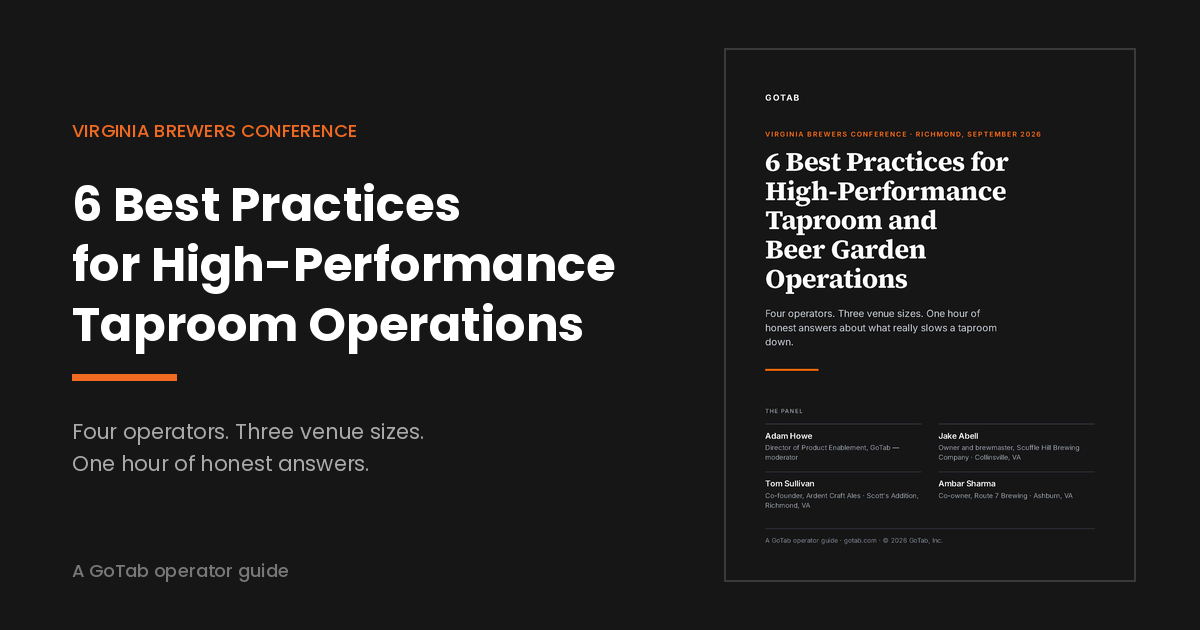
At the Virginia Brewers Conference in Richmond, four operators running taprooms of very different sizes spent an hour answering one question honestly: what actually slows a taproom down?
6 Best Practices for High-Performance Taproom and Beer Garden Operations is the write-up. Every practice comes from someone running a venue — Jake Abell (Scuffle Hill Brewing Company, Collinsville), Tom Sullivan (Ardent Craft Ales, Scott's Addition) and Ambar Sharma (Route 7 Brewing, Ashburn) — moderated by Adam Howe of GoTab.
1. Start the clock when the guest decides. The number that matters is the time between a guest wanting a drink and holding one, not how fast an order gets taken. Route 7 stopped assigning sections — whoever reaches the table first serves it.
2. Build the bar like a kitchen. Ardent splits bartending into stations: four taking orders, two pouring, one running. Neither venue got faster by hiring more people. They got faster by removing multi-tasking.
3. Make the tab follow the guest. Flags and table numbers fail the moment people move. A phone reaches the guest wherever they've gone. Pre-authorise cards at open, and give one person ownership of the close.
4. Find the bottleneck before it finds you. Put register volume next to kitchen timing and the constraint becomes visible. Route 7 found the fryer and added a second one. Showing item status at the point of ordering lets staff offer alternatives before a 45-minute backlog forms.
5. Charge for the membership. Paid members use what they pay for — 70% of Scuffle Hill's top-tier members visit one to three times a week. Make the benefits shareable with the guests they bring.
6. Stop counting on a server to remember. Build the prompt into the handheld. Route 7 found that 85% of guests close out at the bar, so that is where the reminder belongs.
Almost none of this is a technology problem. Ardent's fix cost nothing but a change to how the jobs were split. Technology earns its place in the three spots where people reliably fail: remembering, measuring, and finding a guest who has moved.
Operators running taprooms, beer gardens and brewpubs who want service to feel faster without adding headcount — and anyone trying to work out whether their next constraint is staffing, layout or equipment.
Download the guide for the full detail behind each practice, in the operators' own words.