

English
The category has moved past the question of whether food halls work. At the 2026 Future of Food Halls Conference, nearly 30 operators, developers, designers, consultants and technology leaders spent two days on a sharper question: why do some halls compound, and others plateau?
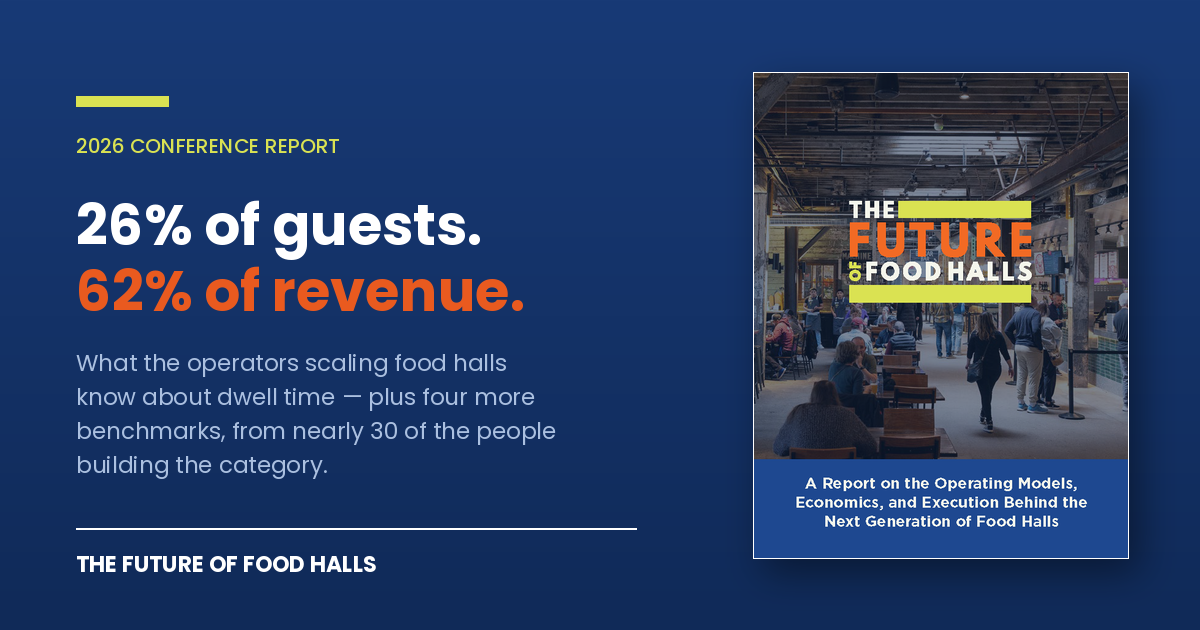
The Future of Food Halls is the report that came out of those conversations. It is not a trends piece. It is a working account of the operating models, unit economics and execution habits behind the halls that are currently scaling — including the numbers most operators only learn the hard way.
The dwell time finding. In many halls, roughly 26% of guests drive nearly 62% of total revenue — and the variable is how long they stay, not how much they spend per order. The report covers the three levers operators use to extend a visit, and why traffic is the wrong metric to optimise.
The vendor health benchmark. A simple occupancy-cost threshold for reading tenant viability before turnover shows up: below 20% is healthy, 20–23% is the caution zone, above 23–24% requires intervention. Vendor health is one of the clearest early indicators of ecosystem strength, and this is the number to watch.
What buildout spend actually buys. Food hall buildouts range from under $300 to more than $3,000 per square foot — and operators report little correlation between build quality and check average or sales trajectory. The most successful halls are not the most expensive to build; they are the most effective to operate.
The two mistakes that compound. Letting vendors choose their own POS, and giving up control of the bar. The report covers why fragmented systems become operational liabilities as a hall grows, and what standardising actually changes.
Where the margin is. Private events can exceed 50% margins, beverage programs are often the most profitable component of the model, and mobile and QR ordering can lift check averages by 30% or more by removing friction from the reorder. Programming has moved from a marketing tactic to revenue infrastructure.
The report frames today's leading halls as operating across five interconnected layers — design economics, placemaking, dwell time economics, systems, and execution — with a section on each, covering what the leading operators do differently and where the category is still figuring itself out.
The insights come from named practitioners, not analysts. Contributors include Patricia Wall (The Market at Malcolm Yards), Michael Morris (Cana Development), Susan Ganter (The Golden Mill), Josh Krsnak (Hempel Real Estate), Glen Coben (Glen & Company), Megan Flanagan (Urban Land Institute Minnesota), Phil, Trip and Andrew Colicchio (Colicchio Consulting), Ryan Gromfin (The Restaurant Boss), Josh Goodman (PourMyBev), Emily Vandevender Young (Tripleseat), Chris Viola (Culture Collective Hospitality), and Tim McLaughlin (GoTab), among others.
Operators running multi-vendor venues today, developers evaluating a hall as a real estate anchor, and anyone in the 18–30 months between concept and opening who would rather learn these numbers from someone else's experience.
Download the report to get the operating models, benchmarks and execution playbook behind the next generation of food halls.
The conversation continues at the Future of Food Halls Conference, March 15–16, 2027, at Rembrandt Yard in Boulder, Colorado.