







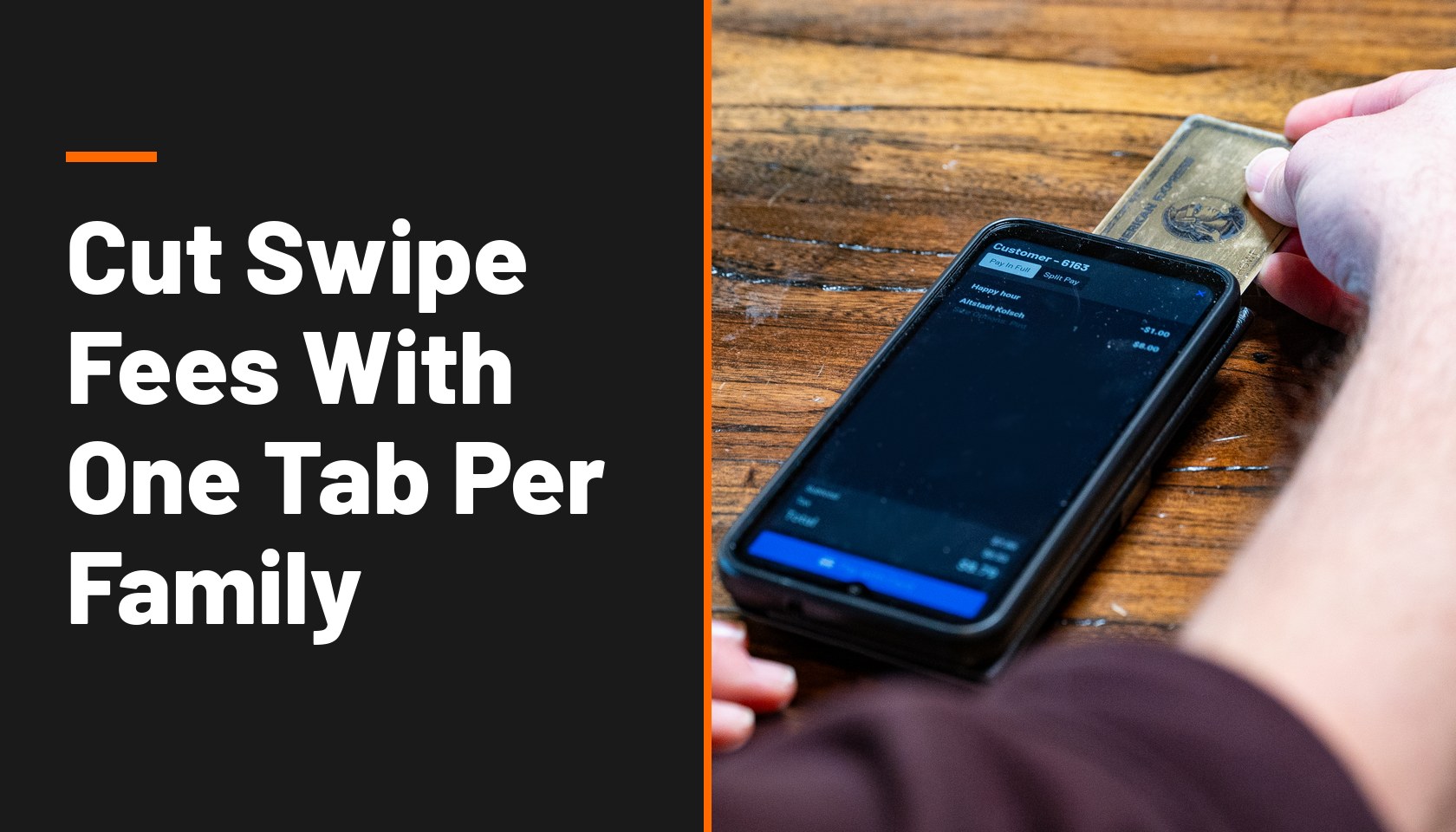
A family of four arrives on a Saturday. Go-kart tickets at the front desk. An arcade card reload. Lunch at the grill. Ice cream an hour later. A souvenir on the way out.
Five card presentations. The guest experiences five taps and thinks nothing of it. You paid for five authorizations on what was, from the till's point of view, one visit worth about eighty dollars.
Operators raise this constantly and almost never with a number attached. The arithmetic is worth doing, because it decides whether consolidating the visit onto one tab is a rounding error or a line item.
Where Does The Cost Actually Come From?
Card acceptance has two parts, and only one of them cares how many times the card is presented.
There is a percentage of the ticket, and there is a fixed amount charged per transaction. The percentage scales with what you sell. The fixed part does not — it is the same on a six-dollar ice cream as on a sixty-dollar dinner.
That asymmetry is the whole story. Splitting one eighty-dollar visit into five sixteen-dollar transactions does not change the percentage you pay, because the percentage rides on the same total either way. What it adds is four extra fixed fees, for which you receive nothing.
This is why the problem is specific to venues like yours rather than to restaurants generally. A restaurant guest presents a card once. An FEC guest presents it at every counter that sells something, and the counters that sell the smallest items are often the busiest.
One thing to check before going further: if you are on a flat blended rate, your statement may not show the fixed component separately at all, and the cost of transaction count will be invisible to you. On interchange-plus pricing it is itemised. If you cannot find a per-item fee on your statement, that is the first call to make.
How Do You Calculate What It Is Costing You?
Four numbers, all of which you can get this week.
- Card presentations per party per visit. Total card transactions in a period divided by the number of parties in that period. Rough is fine — you are looking for whether it is two or six.
- Average transaction size. Also from the POS, same period.
- Your per-item fee. From the processing statement, not from a sales conversation.
- Parties per year. Or per season, if you close for part of it.
The calculation is then one line. Subtract one from the presentations per party — that is the number of authorizations consolidation could remove — multiply by the per-item fee, and multiply by parties per year.
To show the shape of it rather than to give you a benchmark: a venue seeing five presentations per party, a fifteen-cent per-item fee and sixty thousand parties a season is looking at four removable fees per party, which is thirty-six thousand transactions and something in the region of thirty-six hundred dollars. Change any of those three inputs and the answer moves a long way. That is exactly why the number has to be yours rather than anyone else's.
Run it before you scope any project. It either clears the bar or it does not, and either answer is useful.
What Does One Tab Per Family Actually Save?
Less than most vendors imply, and it is worth being precise about the boundary.
Consolidation removes authorizations. It does not reduce the percentage, because the percentage applies to the same sales total whether it arrives in one transaction or five. So the saving is capped by the fixed component and nothing else. If your per-item fee is genuinely small, the saving is genuinely small.
There are second-order effects that usually go uncounted and sometimes matter more than the fee itself. Fewer settlements to reconcile at close. Fewer separate transactions to hunt through when a guest disputes a charge. And time at the counter — a card presentation is fifteen to thirty seconds of a queue you are trying to clear on your busiest day.
The mechanics of making a single tab span the building are a separate question, and a harder one than the arithmetic here — merchant IDs, attraction vendors and pre-authorization all get in the way. One tab from the go-kart track to the grill covers what has to be true before this is even buildable. This post is only about whether it is worth building. Roaming tabs and split payment are the pieces that let one family account work the way a family actually pays.
What About Surcharging Or A Cash Discount?
The other lever operators reach for is shifting the cost to the guest rather than reducing it.
It is a real option and worth understanding as a different thing from consolidation. Consolidation reduces how many fees you incur. Surcharging changes who pays them. They are not alternatives, and a venue can do both, one, or neither.
The caveats are not software caveats. Permitted practice varies by state and by card network rules, credit and debit are generally treated differently, and the disclosure requirements are specific about signage and receipt presentation. That makes this a conversation with your processor and your own counsel rather than a setting someone toggles for you. Anyone who tells you otherwise has not read the rules.
There is also a guest-experience judgment that has nothing to do with compliance. In a venue where a family is already making a dozen small spending decisions in an afternoon, adding a visible fee to each one is a different proposition than adding it to a single restaurant check. Worth weighing before it becomes a policy.
Who Does This Operational Approach Fit Best?
The arithmetic favours venues with many small transactions per party — arcade reloads, snack counters, ice cream windows, retail. If a typical party presents a card four or more times in a visit, consolidation has something to work with.
It fits especially well where the smallest-ticket counter is also the busiest, because that is where the fixed fee is the largest share of the sale and where the queue time compounds the cost. This is one of the things a family entertainment center POS should be able to tell you about your own venue before you ever ask a processor.
It fits poorly in venues built around one big ticket — a single admission plus one sit-down meal is two transactions, and there is nothing to consolidate. And it is premature anywhere you cannot yet get a per-item fee off your statement, because you would be scoping a project against a number you do not have. Get the statement first.
Want to see what a single family tab would look like across your counters? Request a demo, or start with the complete FEC technology stack. If your reporting cannot currently tell you transactions per party, when your two sales reports disagree is the prior problem to fix.
FAQ
How much do processing fees actually cost a family entertainment center?
It depends far more on transaction count than on sales volume, which is why published averages are unhelpful. Take your card transactions divided by parties, subtract one, and multiply by your per-item fee and your party count. That figure is the ceiling on what consolidating to one tab can save.
Does one tab reduce credit card processing fees?
It reduces the fixed per-transaction component by removing authorizations. It does not reduce the percentage, because that applies to the same sales total either way. The saving is therefore bounded by your per-item fee, and is worth calculating rather than assuming.
Is it cheaper to run one open tab or take payment at each counter?
One open tab is cheaper on fees wherever a party would otherwise present a card several times, and the gap widens as average ticket size falls. Taking payment at each counter is simpler operationally and may be the right call in a venue with two revenue points and short queues.
Can an FEC pass card fees on to guests?
Sometimes, and the rules are specific. Permitted practice varies by state and by card network, credit and debit are usually treated differently, and disclosure requirements govern signage and receipts. Treat it as a question for your processor and your own legal advisor rather than a configuration choice, and weigh the guest-experience effect separately from the compliance one.