





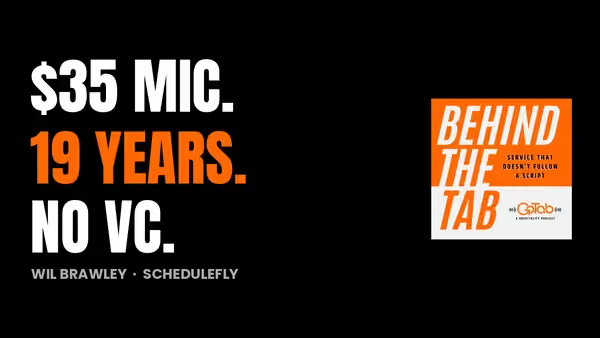
Wil Brawley co-founded Schedulefly, a restaurant employee scheduling platform, in 2007 — the same year he sold his previous company to Dun & Bradstreet, and one year before a good chunk of his former prospective customers' industry fell apart in the financial crisis. Nineteen years later, Schedulefly has never raised outside funding, has never raised its prices, and runs on a six-person team. It also has a habit of winning back customers who leave for better-funded, more feature-rich competitors — not because Schedulefly out-built them, but because it out-told-more-stories-about-its-customers than they did.
That's not a marketing slogan. It's the actual, deliberate strategy Brawley has run since 2010, and it holds a lesson for any independent restaurant that can't outspend a national chain or a venture-backed competitor on advertising: the story is often the only asset a small operation has that a bigger one can't copy.
Why do customers stay loyal to small businesses even when bigger competitors offer more?
Loyalty built on a relationship survives a better feature list; loyalty built on a feature list doesn't survive a better feature list. Brawley has watched this play out directly — a Schedulefly customer nearly switched to a larger, VC-backed competitor this year, tried it, and came back. "It's just not practical," Brawley recalled the customer telling him. "Your tool is simple and practical, and we're just going to use you." That's the pattern he's seen repeat for years: "When your highly funded competitors come along trying to poach business, they tend to say, thanks, but no thanks. You might have more bells and whistles, but Schedulefly is a company we're proud to do business with."
The mechanism behind that loyalty isn't only the product. It's also that Brawley has spent fifteen years interviewing his own customers on a podcast, Restaurant Owners Uncorked, and sharing their stories publicly. "When you know the owner of Schedulefly puts you on a podcast and spends an hour asking your story," he said, "you build a rapport, and that tends to lead to a lot more loyalty."
What's the fastest way for a small business to differentiate without a marketing budget?
Start with the story you already have access to that a bigger competitor doesn't: your own customers. Brawley's version of this began in 2010 with a $35 microphone from Best Buy, plugged into his laptop, recording restaurant owners talking about their businesses. He didn't have the budget to out-advertise the category's larger players, so he built a different kind of asset instead — a growing library of real stories from real operators, first published as audio embedded on a blog, then as a self-published book that sold 10,000 to 15,000 copies, then as video.
"You read a book in your voice," he said, "but when you watch an owner talk and you see the passion that comes out, that's really valuable." The insight underneath all of it: authenticity is one of the few things a small business can produce that a well-funded competitor genuinely struggles to fake.
How can a restaurant build an engaged following without spending money?
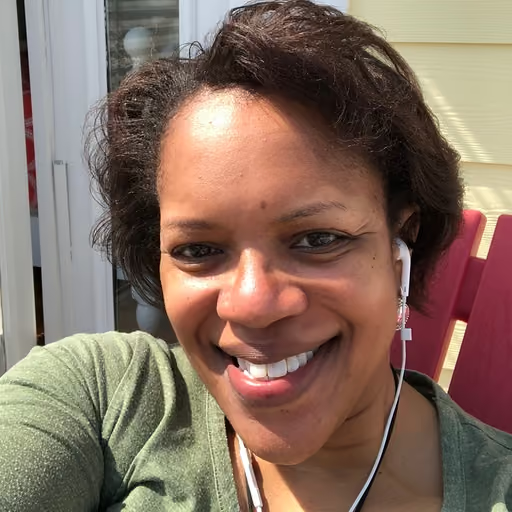
One restaurant owner Brawley interviewed, Tammy Henderson of Sweet Southern Comfort in DeFuniak Springs, Florida — a town of about 2,000 people — has built roughly 10,000 Facebook followers with a tactic that costs nothing but consistency. Every night before service, she goes live on Facebook, walking through the restaurant with her phone: introducing that night's server and bartender, running through the specials, showing the kitchen. "She has like 10,000 followers in this little town of 2,000," Brawley said. "And she says that when she doesn't go live, people text her — what's going on, why aren't you live?"
That's a useful benchmark for what "engagement" actually looks like when it's working: not likes, but people noticing when the content stops. It costs a phone and a few minutes before every shift, and it works precisely because it's unpolished and real, not because it's professionally produced.
Does adding more features or technology automatically make a restaurant's operations better?
Not by default, and Brawley treats this as close to a law of product design. "We've certainly added plenty of tools and features to Schedulefly over the years," he said, "but we also have said no 100 times more than we've said yes." His math on why: "If we added one thing a week — say we've added 50 things during the year, and then five years later we've added 250 things — all of a sudden this tool that used to be simple is now complicated."
The same logic applies to how restaurants choose their own technology stack, not just the tools they build. More automation and more integrations sound like progress, but each one adds a decision, a training step, and a place where something can break — worth weighing against what a simpler setup would have cost in time saved.
Should a restaurant pick one all-in-one platform or connect specialized, best-in-class tools?
There's a real tradeoff, and it's worth understanding before committing to either path. Brawley's caution about all-in-one platforms comes from watching what happens after the sale: "Once you've got all your eggs in one basket, the dials can get turned up pretty fast," he said. "It's hard to unwind something, and you're kind of almost trapped." His alternative preference — tools that do one thing well and connect to each other through APIs — is part of why GoTab's own approach to aggregating best-in-class technology partners rather than building every feature in-house resonated with him as a fellow long-tenured operator in the space: "GoTab does a wonderful job of enabling your customers, through APIs, to say, okay, I want this tool and that tool and I want them to connect," he said, "but I don't necessarily want to have every product owned by one provider."
The same principle shows up in how restaurants build guest loyalty, too — GoTab's own guest engagement approach is built around the idea that brand-building, community, and ongoing communication compound over time, in roughly the same order Brawley describes: tell the story first, then let the relationship do the retaining.
Who is this kind of storytelling-driven marketing actually for?
It's built for operators who can't win on advertising spend — which, realistically, is most independent restaurants and small multi-unit groups, not the well-capitalized chains they're competing with for attention. It's less suited to businesses that have already built a strong brand through other channels and are optimizing distribution rather than differentiation. Brawley's own read on his customer base is instructive here: Schedulefly serves independent restaurants and small groups well, and is upfront that operators scaling past 15 to 20 locations usually outgrow it for something with more built-in complexity. The same logic applies to this strategy — it's a founder-effort play, not a paid-media replacement, and it demands consistency more than budget.
Prefer video? Watch the full conversation with Wil Brawley on YouTube, with chapters for each part of the story.
FAQ
Does this only work for restaurants, or does it apply to any small business?
The mechanism — building loyalty through authentic storytelling rather than feature or price competition — applies to any small business without a large advertising budget. It's especially well-suited to restaurants because the stories (owners, staff, regulars, communities) already exist; the work is capturing and sharing them consistently.
How much does a strategy like this cost to start?
Tammy Henderson's nightly Facebook Live costs nothing beyond a phone and a few minutes before each shift. Wil Brawley's original version cost $35 for a microphone. The barrier is consistency, not budget.
What's the difference between an all-in-one restaurant tech platform and a best-in-class, API-connected approach?
An all-in-one platform centralizes every tool with a single provider, which simplifies vendor management but increases dependency on that one provider's pricing and roadmap decisions. A best-in-class approach connects specialized tools — each chosen for a specific need — through APIs, trading some integration complexity for more flexibility and negotiating leverage.