




Restaurant owners and chefs often become indispensable for all the wrong reasons.
They answer questions on their days off. They explain the same process repeatedly. They correct dishes that have drifted from the original recipe. They step in whenever the kitchen gets overwhelmed or information fails to travel from one shift to the next.
Their experience keeps the restaurant running—but their constant involvement can also prevent the operation from growing.
“Without the systems that allow your teams to do what they need to do or what you expect them to do, you’re the blocker,” says James Passafaro, VP, Restaurant Operations and Strategy at GoTab.
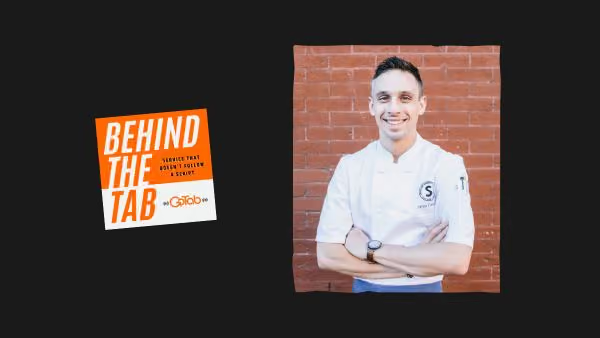
In a recent episode of Behind the Tab, Passafaro reflected on the experiences that shaped his transition from professional chef to tech entrepreneur. His central message was clear: restaurant technology should not simply digitize existing processes or reduce the number of people involved. It should give operators and their teams better information, clearer expectations and greater confidence.
That requires more than a cash register. It requires a connected restaurant point-of-sale system, kitchen technology and operational tools that help information move reliably from the guest to the kitchen—and back to the operator.
When Recipe Information Travels by Word of Mouth
Passafaro spent approximately 20 years cooking professionally. One of the experiences that eventually led to opsi by GoTab occurred during his first executive chef role at RN74 in San Francisco.
The restaurant relied heavily on paper. Recipes lived in binders. Cooks copied information into personal notebooks. When a menu or preparation changed, one employee would tell another, who would then pass the information to the next shift.
It became, in Passafaro’s words, “a game of telephone.”
Eventually, the food arriving at the pass no longer looked or tasted the way he remembered creating it. The correct recipe might have existed somewhere in a binder, but the kitchen was working from handwritten notes, memory and secondhand instructions.
Passafaro found himself spending much of his time talking: communicating changes, correcting inconsistencies and making sure everyone was doing the right thing at the right time.
The problem was not a lack of effort. Employees simply did not have immediate access to a reliable source of information.
“No one wants to go to work and feel like they’re not successful,” Passafaro says. “They don’t want to go every day and fail.”
When employees have clear, accessible information, they can execute with greater confidence. Managers spend less time correcting preventable mistakes. The entire team has more room to focus on hospitality, quality and improvement.
Structure Creates Room for Creativity
Restaurants need creativity, but creativity works best when teams understand the standards within which they are operating.
Recipes, procedures and service expectations provide those boundaries. They give employees a dependable starting point while leaving room for thoughtful judgment and continuous improvement.
“Humans inherently want structure,” Passafaro says. Opsi by GoTab helps provide “organized, reasonable, easy-to-access structure of information.”
That same principle should extend across the restaurant’s technology stack.
A server entering an order should be confident that the kitchen receives the right items, modifiers and special requests. The cook should know how the dish is meant to be prepared. The expediter should be able to see what is ready, what is delayed and what needs attention. The guest should receive what they expected, regardless of how or where they placed the order.
A connected restaurant kitchen display system helps establish that shared source of truth. Orders from the POS, handheld devices, kiosks, QR codes and online ordering channels can flow into one kitchen workflow with live ticket times and order statuses.
The result is not simply less paper. It is better coordination between the people responsible for taking, preparing and delivering every order.
A POS Should Be More Than a Cash Register With a Screen
Passafaro has used many point-of-sale systems throughout his restaurant career. From a kitchen operator’s perspective, he says, these systems can frequently amount to “cash registers with screens and payment terminals.”
They may process a transaction successfully without giving the restaurant meaningful operational visibility.
That distinction matters. A modern POS should do more than record what the guest purchased. It should help connect ordering, payment, production and reporting so operators can understand what is happening across the business.
GoTab brings staff-entered, tableside, mobile and self-service orders together within one platform. When that platform is connected to the KDS, the restaurant does not need to operate separate fulfillment processes based on how an order was placed.
Whether an order begins with a server, at a counter or on a guest’s phone, the kitchen can receive the information it needs through a consistent workflow.
That connectivity reduces the gaps that force employees to improvise or managers to intervene.
Connect What the Guest Expects With What the Kitchen Produces
Passafaro sees an immediate benefit in connecting front- and back-of-house information: consistency.
“The cook produces the food that the server expects to see, that the guest expects to see,” he explains.
That alignment sounds simple, but it depends on information moving accurately throughout the restaurant. Servers need confidence in what they are selling. Cooks need clear instructions. Kitchen leaders need visibility into timing and production. Guests need accurate expectations about their orders.
A connected POS and KDS help create that bridge.
The GoTab KDS consolidates orders into a live production queue, regardless of ordering channel. Smart prep times help kitchens account for items that require different preparation times, while ticket monitoring gives the team better visibility into delays and bottlenecks. Restaurants can also communicate with guests about questions or delays directly from the kitchen workflow.
When the front and back of house work from connected information, the restaurant can improve order accuracy without requiring a manager to personally oversee every interaction.
Look for the Knock-On Effects
When evaluating restaurant technology, Passafaro recommends looking beyond the system’s primary output.
A tool might successfully convert a clipboard into a screen or replace a handwritten ticket with a digital one. But that does not necessarily mean it has improved the underlying operation.
The more important question is what Passafaro calls the “knock-on effect”: What additional value becomes possible once the system is properly established?
For a connected POS and KDS, those effects can include:
- More accurate communication between the front and back of house.
- A unified production process across multiple ordering channels.
- Better visibility into ticket times and kitchen capacity.
- Faster onboarding for new employees.
- Less dependence on verbal instructions and institutional memory.
- Greater consistency across shifts, locations and service models.
- More time for chefs and managers to coach their teams.
- Better operational data for identifying recurring problems.
The value is not confined to a single transaction. It compounds as the restaurant uses the system to create more consistent and repeatable ways of working.
Build a Restaurant That Does Not Depend on You
Passafaro developed a clear leadership philosophy during his years as a corporate chef: create impact, build the necessary systems and make the operation less dependent on him as quickly as possible.
“I was never going to create a system that was dependent on me being there,” he says.
That does not mean leaders become disengaged. It means their time can be spent supporting the team, solving higher-value problems and improving the business instead of repeatedly supplying information that should already be available.
For an independent restaurant owner, that freedom might mean fewer weekend text messages and early-morning phone calls. For a growing hospitality group, it might mean opening a second or third location without requiring the founder to supervise every shift. For a chef, it might mean spending more time developing people and food instead of locating recipes or correcting communication failures.
The right restaurant technology helps distribute knowledge without removing leadership.
Technology Is a Tool, Not an Autopilot System
Connected systems can reduce friction, surface valuable information and make routine execution more dependable. They cannot replace the experience and judgment of the people operating the restaurant.
“These systems are not meant to draw the human out of the experience,” Passafaro says. “The tool is exactly that. It’s a tool. You have to use it.”
The objective is not to put the restaurant on autopilot. It is to give operators a clearer view of the business and give employees the information they need to succeed.
When the POS, KDS and operational systems work together, technology becomes more than a collection of screens. It becomes the infrastructure that connects guest expectations, kitchen execution and management visibility.
That gives restaurant leaders something exceptionally valuable: the ability to lead the business without becoming its biggest bottleneck.
Explore the GoTab Point of Sale
See how the GoTab Kitchen Display System connects front- and back-of-house operations