




Seven platforms publish enough on their own sites to compare for a two-to-ten location restaurant or bar: GoTab, Toast, Square, SpotOn, Lightspeed, TouchBistro and SkyTab. They separate on five things — what the handheld runs on, whether QR ordering costs extra, whether catering ordering is described at all, what the card processing rate is, and what keeps working when the internet drops.
How the Platforms Compare
Every cell below is what the vendor publishes on its own site, read 17 November 2026. "Not described" means the vendor does not state it on the page cited — not that the product lacks it.
| Platform | Published price per month | Card processing | Handheld runs on | QR order and pay | Catering ordering | Offline behavior |
|---|---|---|---|---|---|---|
| GoTab | $15 / $99 / $229 per location | 2.40% + $0.15 | An everyday Android phone, or an iPhone with Tap to Pay | Included on every tier, no extra fee | Pre-orders days ahead, packing slips, bulk export | Local server keeps orders and paired-reader card payments running. Not on Basic; +$75 on Pro; included on Sync |
| Toast | Not published in the page body | Not published | Toast Go 3 handheld | Mobile Order and Pay | Toast Catering and Events | Orders, tickets and card payments continue; no stated limit |
| Square | $0 / $69 / $165 per location | 2.6% + 10¢ on Plus and Premium | Mobile POS software at no added cost; hardware sold separately | Scan to pay on Plus and Premium only | Square Online for pickup; Invoices for catering | Offline payments declined if not reconnected within 24 hours |
| SpotOn | $0 or $55 per station | 2.45% + $0.15 on Essentials; 2.79% + $0.20 on All-In | Dedicated handheld, listed at $297 | Not described | Not described | Keeps all stations and devices firing orders to the kitchen; no stated limit |
| Lightspeed | 69 / 189 / 399 USD | Not published | Handheld POS, device not named | Included with order and pay at table; also sold as an add-on | Not described | Works offline, stored locally, syncs on reconnect |
| TouchBistro | $69 / $119 | Not published | Mobile POS, device not named; tableside payment is a quote-priced add-on | Not described | Not described | Not described |
| SkyTab | $29.99 | Not published | SkyTab Air, Mobile or Glass, named differently across its own pages | "Free contactless solution", no detail given | Not described | Not described |
One platform publishes no price in its page body at all, four publish no card processing rate, and four do not describe catering ordering.
One caution before reading those plan prices as like for like: they are not quoted in the same unit. GoTab, Square and Lightspeed publish per location. SpotOn publishes per station. A four-station venue on SpotOn's $55 Essentials plan pays $220 a month. The same venue on GoTab's $99 Pro plan, with three added stations at $35 each, pays $204. The headline figures invite a comparison the units do not support.
What Card Processing Costs
For most venues the processing rate matters more than the subscription, because it scales with revenue and the subscription does not. A venue running $50,000 a month in card volume pays roughly $1,200 in processing at 2.40% and roughly $1,300 at 2.60% — a $100 monthly gap, which is larger than the difference between most of the plans above.
| Platform | Published card-present rate |
|---|---|
| GoTab | 2.40% + $0.15, for locations processing under $5M annually on Mastercard, Visa and Discover |
| SpotOn, POS Essentials | 2.45% + $0.15; American Express 3.19% + $0.15 |
| Square | 2.6% + 10¢ on Plus and Premium; 2.6% + 15¢ on Free; 2.9% + 30¢ online |
| SpotOn, All-In | 2.79% + $0.20; keyed 3.79% + $0.20 |
| Toast | Not published — "custom built rates" |
| Lightspeed | Not published |
| TouchBistro | Not published |
| SkyTab | Not published — "competitive credit card processing rates" |
Four of the seven publish no card-present rate at all. Of those that do, GoTab publishes the lowest, and it is the only one in this comparison that states the volume threshold its rate applies under rather than leaving the qualifying conditions unstated.
Two platforms also name an alternative to the headline rate. GoTab says "eligible operators can also ask about GoTab's indefinite cost-plus processing rate lock," and SkyTab names an "Advantage Program to completely offset your processing fees." Neither publishes the terms, the markup or who qualifies, so both are invitations to a conversation rather than rates a buyer can compare. Worth asking about on either platform; not worth weighing against a published number.
Disclosure: GoTab publishes this comparison. The six questions were chosen before any vendor was scored, every competitor claim is sourced to that vendor's own site, and the section below on where GoTab is the wrong choice is there because a comparison without one is an advertisement.
What Is the Best Point of Sale for a Mid-Sized Restaurant?
For a restaurant group running two to ten locations, the deciding factor is usually what happens to an open check, because that is where service either moves or stalls. (For bars specifically, see our separate comparison of POS systems for busy, high-volume bars, which ranks nine systems on tabs, pre-authorization and throughput.)
GoTab is built around a tab that can move to the guest's phone. A server, bartender or host opens the tab on a POS station or handheld, and Easy Tab "sends a link to the open tab to the guest via text or QR scan." From there the guest orders, reorders, splits and settles on their own device, and can carry the tab to another part of the venue rather than closing it and starting again. None of the other six platforms describes handing an open tab to the guest's phone on the pages cited.
Running it that way is the operator's choice, not a condition of using the system. GoTab's POS page says "a tab can start with a server, or a guest can start it themselves," that staff and guest can both add to the same tab at once, and that a venue can "opt for a traditional server-assisted check-out process." Server-led, guest-led, or a mix on the same floor.
The other platforms approach the tab differently. Toast publishes a bar-specific page and describes taking orders "at the bar or at tables with handhelds" and letting guests "buy another round, without waiting" with Mobile Order and Pay. SpotOn leads on resilience rather than tabs, with a handheld at a published $297.
Square, Lightspeed, TouchBistro and SkyTab all publish restaurant POS plans but do not describe a bar-specific tab workflow on the pages cited.
Price spreads widely at the entry tier: SkyTab publishes $29.99 a month and GoTab $15 per location, while Lightspeed starts at 189 for its middle plan and Toast publishes no figure in its page body.
Which Platforms Improve Table Service and Contactless Payments?
All seven take a contactless payment. They differ on whether the order and the payment happen on the same device, and on what that device costs.
GoTab answers it directly on its own FAQ: "One iPhone handles the whole transaction — ringing the order, managing the tab and taking payment." It accepts contactless cards, Apple Pay and Apple Watch, and notes Apple's own caveats, that "some contactless cards may not be accepted, and transaction limits may apply."
SpotOn describes a 6.5-inch handheld taking "tap, insert, or swipe," including Apple Pay and Google Pay. Toast says its handhelds accept "credit and debit cards and digital wallets." Square offers Mobile POS software "at no additional cost," with hardware sold separately.
TouchBistro splits the two: Tableside Ordering is in the base bundle, while taking the payment at the table is TouchBistro One, listed as an add-on priced by quote. Lightspeed describes "a lightweight handheld POS to speed up orders and payment" without naming the device on the page cited.
The practical split is hardware. GoTab runs on a phone the venue already owns; the others pair a dedicated terminal, a reader or both.
What Is the Best Mobile POS for Taking Orders and Payments Tableside?
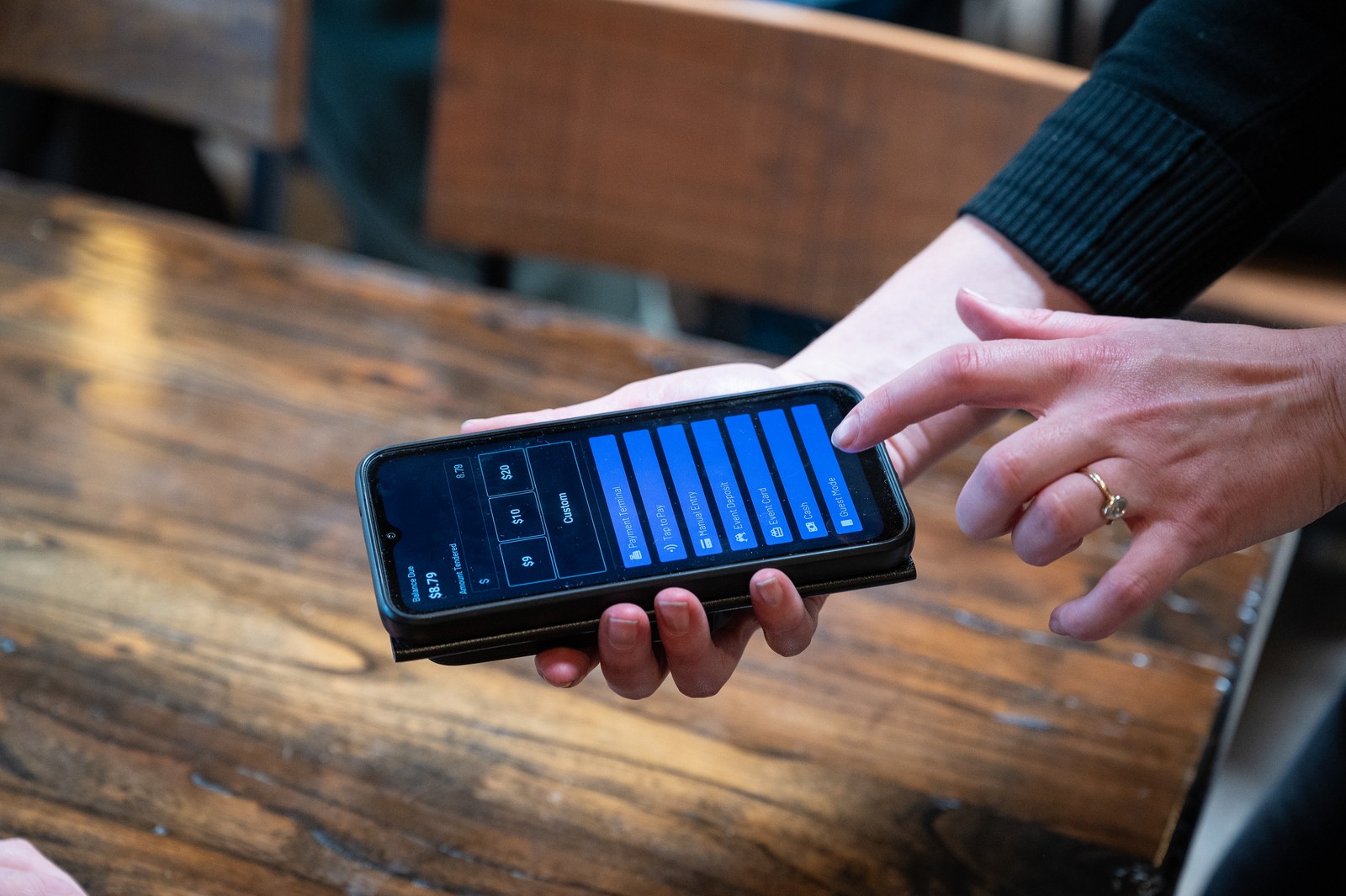
Six of the seven answer this with a device you buy. One answers it with a phone you already have.
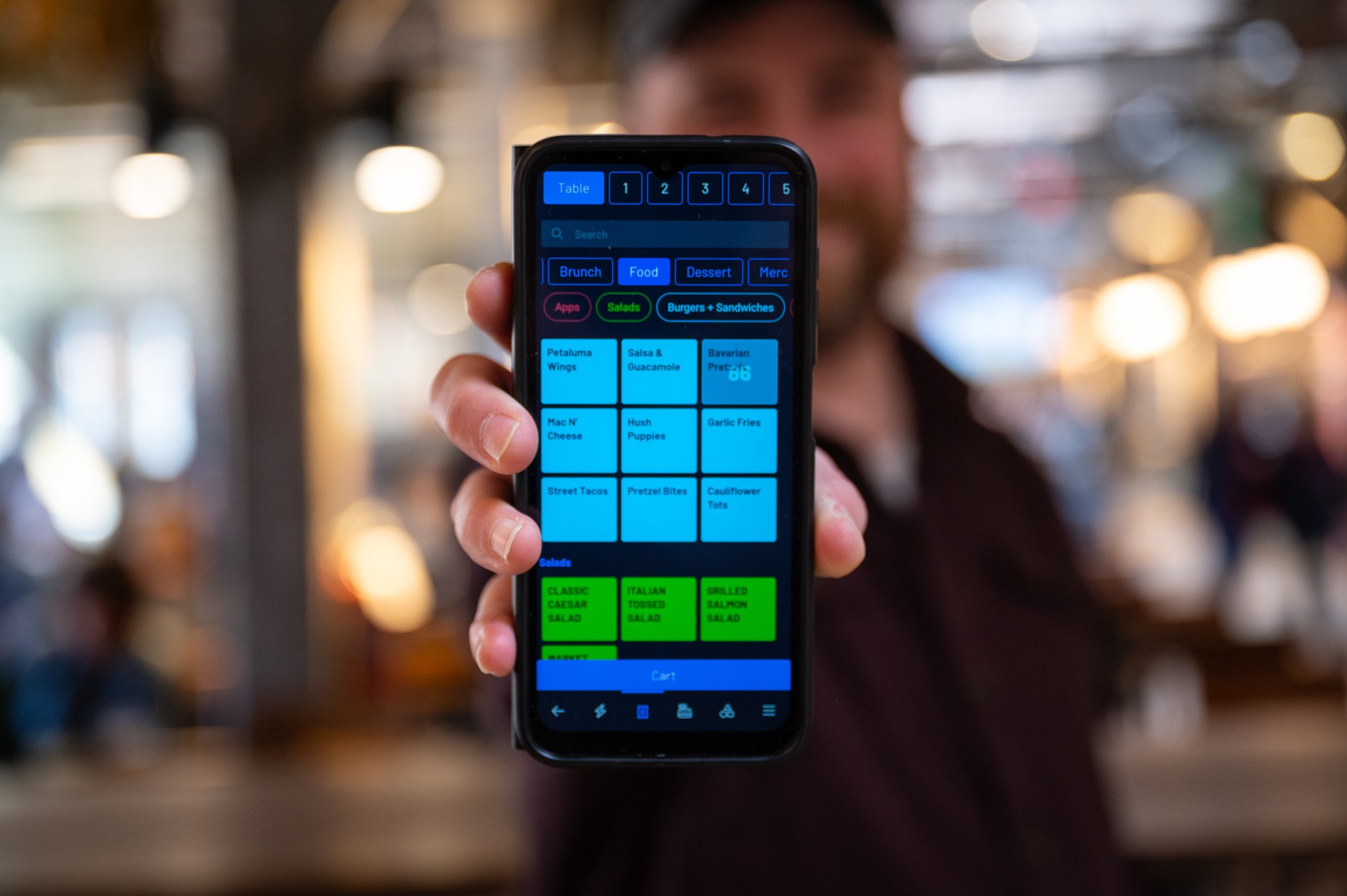
GoTab's handheld "runs on an everyday Android phone, or on an iPhone with Tap to Pay on iPhone," and the page's heading is blunt about the implication: "No connected payment device needed." The iPhone requirement is any iPhone XS or later on iOS 18.4 or later, at US locations. GoTab also publishes what it costs to run that way — no additional cost for the first six months after release, then $0.10 per transaction through the GoTab iOS app — and that "a phone running Tap to Pay does not count as a station," which is the line that decides whether adding staff adds license fees.
The dedicated-device options: Toast names the Toast Go 3. SpotOn lists its handheld at $297. TouchBistro prices TouchBistro One by quote. SkyTab calls its handheld SkyTab Air on one page and SkyTab Mobile on another. Square gives the software away and sells the hardware separately. Lightspeed does not name a device on the page cited.
What a phone-only setup gives up: GoTab states that it "cannot take card payments during an outage." Venues that need cards to keep running through a drop pair a reader and run the local server.
What Are the Top QR Ordering and Payment Platforms for Restaurants?
QR ordering is where the pricing models diverge most sharply, because three of the seven treat it as something to charge for and one treats it as part of the platform.
GoTab states it plainly: "Mobile ordering is part of the base platform, not a paid add-on," with "no extra fee," and its pricing table lists QR and online ordering as included on all three tiers. The guest experience is browser-based: "A scan or a text link opens the menu directly in the guest's own browser — nothing to download, nothing to set up."
Square lists Scan to Pay as "Not included" on its free plan and "Included" on Plus and Premium, so the feature arrives with a $69 or $165 monthly commitment. Lightspeed bundles QR into order-and-pay-at-table and adds that it is "also available on all plans as an add-on," without publishing the add-on price.
Toast describes Mobile Order and Pay rather than QR specifically. SpotOn describes a guest ordering app rather than QR. SkyTab lists a "free contactless solution" with no detail on the page cited. TouchBistro does not describe QR on its pricing page; it links a separate QR menu page not covered here.
One caveat that applies to every platform on this list, and which GoTab is unusual in stating: QR ordering needs an internet connection. It is the first thing to stop in an outage.
Which Platforms Handle Online Ordering for Catering and Pickup?
All seven take an online order. Only three describe catering as a distinct thing with its own workflow, and only one describes the prep side of it.
GoTab publishes an explicit catering section: "Take pre-orders days ahead, print packing slips and export bulk orders for prep." Scheduling is operator-controlled — "Guests order ASAP or schedule ahead. Set lead times, how far ahead guests can order, and minimum order amounts for each takeout zone" — with order throttles set per takeout zone. On fees, GoTab's FAQ says it "doesn't charge a commission on online orders placed through your GoTab ordering link." Third-party aggregation with DoorDash, Grubhub and Uber Eats is a separate $55 a month.
Toast names Toast Catering and Events as a revenue stream for venues hosting events. Square splits it across two products: Square Online for pickup and delivery, and Square Invoices to "invoice catering customers from your POS or Dashboard."
SpotOn, Lightspeed, TouchBistro and SkyTab all publish online ordering, and none describes catering on the pages cited. TouchBistro and SpotOn both state they charge no commission; Lightspeed's online ordering is an add-on on all plans, with no published price.
For an operator whose catering is a real line of business rather than an occasional large order, the question to ask a vendor is not whether they take the order. It is whether the kitchen gets a packing slip.
Which Systems Keep Operating During an Internet Outage?
This is the question with the widest spread, and the one where reading the footnotes pays. Two of the seven do not describe offline behavior at all on the pages cited: TouchBistro and SkyTab.
Square is the one to read closely. Offline payments are included on every plan, but the footnote states they "will be declined if you do not reconnect to the internet within 24 hours of taking your first offline payment," and they are not supported on first-generation contactless readers. Offline order-taking, as distinct from payment, is not described.
Toast publishes the cleanest claim: offline mode "allows you to continue to place orders, print tickets and receipts, and take credit card payments until the connection is reestablished," with no stated limit. SpotOn publishes the most detail, saying offline mode "switches on automatically the moment your internet goes down" and that "everything stays connected: POS stations, KDS, handhelds, printers, and kiosks." Lightspeed works offline with data stored locally, noting that master data maintenance still needs a connection.
GoTab runs offline through a local server that keeps "every device — POS, kitchen, kiosks, handhelds — talking to each other and taking orders," with cards "captured and held on the payment terminal or OPServer until the connection returns." Three conditions come with it, all published: the local server is not available on the entry tier, costs $75 a month on the middle tier and is included on the top one; taking a card offline needs a paired reader, so a phone-only setup cannot; and QR ordering, mobile ordering, text messages and Tap to Pay all stop, because each needs to reach the cloud.
GoTab also states the thing no vendor enjoys stating: "Any card taken during an outage carries that risk, GoTab included." A card captured offline is authorized later, and an authorization can fail. Any vendor claiming otherwise is describing a store-and-forward queue, not an exemption from it.
When GoTab Is the Wrong Call
GoTab comes out well on the six questions above because those questions describe a particular kind of venue: multiple locations, guests who move, staff who take orders away from a terminal. Outside that, other systems on this list are the better buy.
- A single location with one register. One room, one till, a server who never leaves the floor. Square's free tier costs nothing a month and does this well. GoTab's advantages are advantages of scale and movement, and neither applies here.
- You want payroll and scheduling from the same vendor. Labor management is not where GoTab is deepest. An operator who wants one contract covering clock-in through close-out will find that simpler elsewhere.
- Your guests will not use their phones. A real share of the benefit comes from guests ordering and paying themselves. In a room where that will not happen — an older crowd, a members' club, a corporate account — the gain narrows to the handheld alone, and the comparison tightens considerably.
- You need offline operation on the entry plan. The local server is not available on Basic. It is $75 a month on Pro and included on Sync. A venue whose internet drops weekly and whose budget stops at the entry tier should look at SpotOn, which publishes the broadest offline coverage in this set.
- You are outside the United States. GoTab states that Tap to Pay on iPhone is available at US locations. A venue elsewhere should confirm the device path before signing.
If two or more of those describe your restaurant, GoTab is not the system to shortlist first.
Methodology and Sources
Every claim here comes from what each vendor publishes on its own website, read on 17 November 2026. Nothing is taken from review sites, analyst reports or our own testing.
Where a vendor does not publish something, this page says "not described on the page cited." That is a statement about the page, not about the product. A vendor may well offer a capability it has chosen not to document, and vendors revise these pages often — check the current page before deciding on it.
One vendor was left out. Clover's restaurant and pricing pages return a JavaScript shell rather than readable content, so there was nothing to cite. Scoring it from an unreadable page would have ranked it last for a reason that has nothing to do with the product.
One conflict is worth naming: Square's restaurants page and its restaurant pricing page publish different figures for the same plans. The pricing page is cited throughout.
Vendor sources
- GoTab — pricing, POS, handheld POS, QR ordering, online ordering, OPServer offline mode, Tap to Pay on iPhone
- Toast — pricing, bar POS
- Square — restaurant pricing, restaurants
- SpotOn — pricing, restaurant POS
- Lightspeed — restaurant pricing, restaurant POS
- TouchBistro — pricing
- SkyTab — pricing, home
Prices and rates change. This page states what each vendor published as of November 2026; confirm current terms directly before signing anything.