







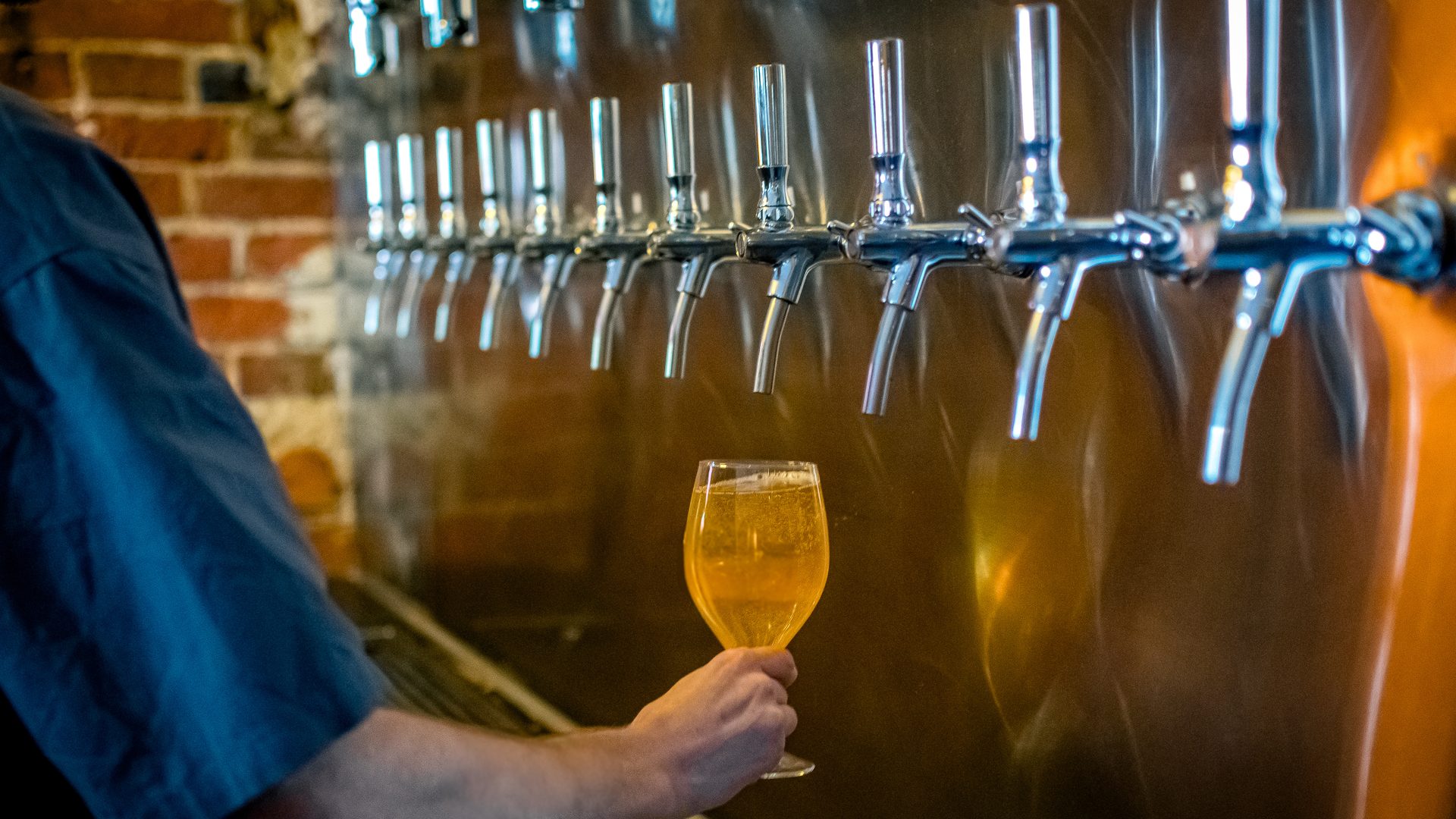
A self-pour wall looks like the whole idea: a row of taps, a screen above each one, guests pouring their own. It isn’t. The wall is the half you can see. The half that decides whether it works is the pass in the guest’s hand, the tab behind it, and the point of sale that has to issue one and settle the other.
This post is about that second half — what a self-serve beer wall needs behind it, the questions to settle before the taps go in, and where the wall and the till usually fail to meet. If your question is whether self-pour pays, our Behind the Tab conversation on self-pour economics covers that. This one is about running it.
Self-pour
Self-pour means guests pour their own drinks from a metered tap and pay for what they actually pour, by the ounce, rather than buying a glass at a fixed size. A pass — a card, a wristband or a phone — unlocks the tap and ties every ounce to an open tab. The wall is the visible half. The pass, the tab and the till are the half that decides whether it works.
What Is a Self-Serve Beer Wall?
A row of taps guests pour from themselves, charged by the ounce rather than by the glass. A pass unlocks the tap and a flow meter counts what comes out. The wall replaces the bartender’s pour, not the bartender’s judgment — someone still has to be watching the room.
It also isn’t only beer. One operator we spoke to — a self-serve tap wall with no full bar beside it — described the plan in a sentence:
“Self serve, 24 taps, beer, wine, ciders”
“No spirits in combination with the restaurant.”
Wine, cider, seltzer and non-alcoholic options all run on the same hardware. What goes on the wall is a menu decision and a licensing one, not a technical limit.
How Does a Self-Serve Beer Wall Work?
A guest checks in, has their ID and card verified, and is issued a pass — a card, a wristband or their phone. The pass unlocks the taps and meters what they pour by the ounce. Everything poured lands on an open tab, which they settle at the counter or from their phone.
The check-in is the part guests remember least and venues think about most. It is usually a station beside the wall, staffed, where the ID is checked and the card is held before a pass is handed over. From then on the guest never queues for a drink again, which is the point — but every pour is still tied to a verified person and a card on file. If you want the detail of how that hold works, we cover pre-authorization and open tabs separately.
Can You Pour Your Own Beer at a Bar?
Where the venue’s state rules and license allow the format, yes — but not anonymously. Every self-pour venue gates the taps behind a verified identity, and most cap how much one pass may pour before the guest checks back in at the counter. Pouring your own is self-service; being served is still a decision the venue makes.
An operations lead at a venue where most guests arrive for something other than the beer put the venue’s side of it plainly:
“Well, they have a running tab throughout their visit.”
“If they want to use the bar at all, they have to have a tab.”
“They can’t use the bar without a tab.”
That is the honest answer to “can I pour my own?” — yes, once the venue knows who you are and has a card behind you. Whether a venue can offer self-pour at all, and what limits apply, depends on the state and the license. That is a question for the venue’s licensing authority, not for a blog post.
How Much Does a Self-Pour Beer Wall Cost?
Four costs, not one: the wall and its flow meters, the glycol and draft work behind it, the passes and readers, and the point of sale that has to issue and settle them. Vendors quote the first. The fourth is the one operators discover late, because it is usually a different vendor.
The first three are hardware and installation, and they vary with tap count, distance from the cooler, and how much of the draft system already exists. The fourth is a software question, and it is cheaper to answer before you buy anything: does the system that runs your bar already know how to issue a pass and put its pours on a tab? If it does, the wall is an addition. If it doesn’t, you are buying a second system and a nightly reconciliation along with it.
Does Your Tap Wall Talk to Your POS, or Just Sit Next to It?
Most walls sit next to it. You open a tab on one system and issue a pass on another, and the two reconcile at the end of the night, or do not. If the pass can pull up the tab at a terminal, a handheld or a kiosk, they are one system.
The clearest sign of how common the two-system setup is came from the same operations lead. Asked how the wristbands guests wear at the wall relate to the tabs on the POS, she said:
“I don’t think the wristbands have any effect on Gotab.”
That isn’t a venue doing anything wrong. It is what happens when the wall is bought from one vendor and the till from another and nobody connects them. The common arrangement is two terminals side by side: a general POS where the tab opens, and a separate station where the pass is issued. We would rather it was one terminal that does both — one device, one step, one record. Whether you run ours or not, these are the questions that decide which arrangement you end up with.
Six things to settle before the taps go in
- Who issues the pass. If the wall’s system issues it and your POS opens the tab separately, you are running two systems and reconciling them nightly. If one terminal does both, you have removed a device, a step and a reconciliation. Ask which it is before you buy either one.
- Whether the pass can pull up the tab anywhere else. A pass that only opens taps is a tap key. A pass that also pulls the tab up at the counter, on a handheld and at a kiosk is the guest’s identity for the whole visit. GoTab’s RFID Pass works this way: one tap anywhere on site brings up the same tab.
- What one pass is allowed to pour, and what happens at the limit. Decide the number, decide whether the pass re-checks at the counter or simply stops, and decide who is standing there when it does. Per-pass limits are also how venues handle groups and buyouts — one tab, several passes, each with its own cap.
- Who is watching the wall. Self-pour removes the pour, not the responsibility. Every venue running one has a person near it, whatever they call the role, and that person needs a device in their pocket, not a terminal across the room.
- How a guest who never approaches the counter gets prompted to buy anything else. At one bookings-led venue with a wall, the operator told us four in five guests bought no food or drink at all. That is one venue, where guests come for an activity rather than the beer — but it shows the wall isn’t the demand problem. If the pass is the tab, the prompt can follow the guest. If it isn’t, the prompt has to be a person.
- What the wall does when the connection drops. The wall is hardware and the tab is not. Ask what a pass does mid-pour when the venue is offline, and ask it before the first busy Saturday.
Self-pour is sold as a labor saving, and it is a real one. But it moves labor rather than removing it — from pouring to checking in, watching the wall, and reaching the guests who were never going to walk up to a counter. That is the honest version, and it is also the strongest case for connecting the wall to the tab.
Card, wristband or phone?
The pass can take three forms, and venues mix them. None is the right answer everywhere; they differ on four things.
- Who issues it. Cards and wristbands are handed out at check-in by staff. A phone pass is opened by the guest, usually by scanning a QR code, and some walls can be unlocked that way with no card at all.
- What happens when one is lost. A lost card or wristband is deactivated and replaced at the counter, and the tab stays put. A phone pass can’t be lost in the same way, but a dead battery ends the visit’s pouring until it’s charged.
- How it works at the wall. Cards and wristbands tap with wet hands and full glasses; nothing to unlock or open. A phone has to come out of a pocket at every pour, or once per session, depending on the system.
- Who it leaves out. A guest without a smartphone, or without signal inside the building, can’t use a phone pass. Venues that offer phones usually keep cards at the counter for exactly that reason.
Many venues run two: wristbands for groups and events, phones for regulars. What matters more than the format is the question in item 2 above — whether the pass, whatever it looks like, reaches the tab.
How Do You Open a Self-Serve Taproom?
Settle three things before the taps go in: what your license allows guests to pour unattended, where the check-in station sits and who staffs it, and whether your point of sale can issue the passes the wall reads. The third is the one that gets decided last and costs the most.
The first is a question for your licensing authority, and the answer shapes everything else — the pour limits, the staffing, sometimes what can go on the wall at all. The second is a floor-plan question: the station needs to sit where every guest passes it, with room for a short line on a busy night. The third is the subject of this whole post. The rest of opening a taproom — permits, draft systems, staffing, menus — is its own checklist, and the brewery POS page is where to start for the system side.
For two venues that have done it, see Connecticut’s first self-pour taproom and Pour Taproom’s approach to self-serve.
Frequently asked questions
How much does it cost to install a self-pour beer system?
It depends on tap count and on how much draft infrastructure already exists. Budget for four things: the wall and meters, the glycol and draft work, the passes and readers, and the point of sale that issues passes and settles tabs. Ask early whether your current POS can do the last one.
How do you market a self-serve beer wall?
The wall markets itself to people already in the room. The harder job is the guests who never go near the counter. If the pass is the tab, you can reach them on their phone with a food menu or a last-call note; if it isn’t, someone on the floor has to.
Do you need a bartender for a self-pour wall?
Not to pour. You still need someone watching the wall, checking IDs at the station, and keeping an eye on how guests are doing. That person needs a handheld device, not a terminal across the room, so they can look up a tab or stop a pass on the spot.
Can guests under 21 use a self-pour wall?
Not to pour alcohol. Passes are issued against a verified ID, and a venue can give a pass different permissions — for example, one that only unlocks non-alcoholic taps or can’t add alcohol to a tab. The rules on age and service come from your state and your license, so check those first.
What happens to a self-pour wall when the internet drops?
It depends on the wall and the POS, which is why it is worth asking before you buy. The taps are hardware; the tab lives in software. Ask both vendors what a pass does mid-pour when the venue goes offline, and how pours made offline reach the tab afterwards.
This article offers general guidance and is not legal advice. Alcohol rules for self-pour service vary by state and by license, so check with your local licensing authority before setting up a self-pour wall.