





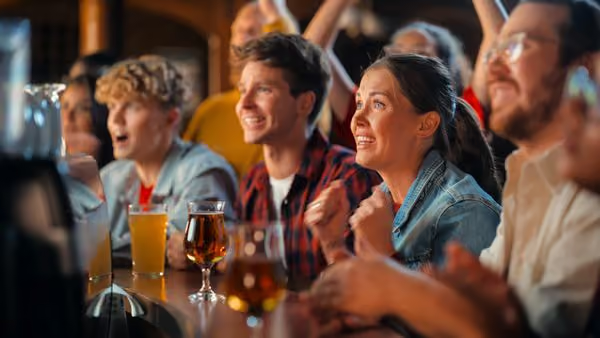
Some bars have a predictable rhythm — busy weekends, slower weeknights, maybe a bump around the holidays. Then there are the bars that live and die by the schedule: a college-town sports bar that's half-empty on a Tuesday and slammed wall-to-wall on a Saturday with a noon kickoff, or a taproom two blocks from the stadium that does more business in four hours on game day than it does in the rest of the week combined. For these operators, "busy season" isn't a gentle curve — it's a series of cliffs.
That kind of volume swing breaks systems that were built for steady, predictable traffic. Here's what tends to go wrong, and what a bar POS system built for swings actually needs to handle.
The Problem Isn't the Busy Days — It's the Gap Between Busy and Slow
A generic POS setup can usually survive a single hard night. The real strain shows up in the gap: staffing, hardware, and contracts that are either sized for game day (and wasted the rest of the week) or sized for a normal Tuesday (and overwhelmed the second a home game gets announced).
A few patterns come up again and again with operators near campuses, arenas, and stadiums:
- Chargebacks spike right along with volume. High-volume, high-turnover service — especially when tabs are opened quickly and closed in a rush — creates more card-not-present-style disputes and walkouts than a typical sit-down shift. Operators who don't have a way to verify or pre-authorize a card before drinks go out tend to eat that cost every single peak weekend, not just occasionally.
- Seasonal staffing means seasonal training headaches. Bars near a stadium or campus often double or triple their floor staff for a season, then cut back down. A POS that takes weeks to train new staff on is a POS that's actively working against a business with a six-month peak and a six-month off-season.
- Hardware and contracts don't flex. Committing to enough terminals and service tiers to cover a sold-out Saturday, and paying for that capacity every day of the year, is a real cost. So is being caught short when a system genuinely can't handle a 10x spike in traffic.
- Manual reconciliation doesn't scale. Whatever works fine at 80 covers a night falls apart at 800 — comps, discounts, and split tabs that a bartender could track in their head on a Tuesday become untrackable during a flood.
- A dropped connection on the busiest night is the worst possible time to go down. High-volume nights put the most strain on Wi-Fi and network hardware — exactly when a bar can least afford a POS outage.
What "Built for Volume Swings" Actually Looks Like
This is exactly the kind of scaling problem GoTab customers in high-traffic hospitality settings deal with directly.
At Santa Anita Park, attendance swings from 5,000–7,000 guests on an average day to roughly 110,000 for their annual Breeders' Cup event — and the same system has to hold up at both ends without a separate setup for each. As Rick Bakker, Director of Hospitality at Santa Anita Park, put it: "GoTab helps the team achieve exceptional agility, managing a staggering influx of orders with precision."
At The Phoenix Taproom and Kitchen — the largest self-pour taproom in the Midwest — the same principle plays out at a bar-specific scale: the venue runs with just 2-3 staff on a typical weekday, but during festivals and peak events, five staff can handle up to 500 guests without a drop in service. Owner Brad Hansen credits the hybrid model for making that swing manageable: "Our hybrid service model...has completely transformed our operations. Guests love the freedom to pour and order at their own pace, while our staff focuses on delivering exceptional hospitality."
For a bar or taproom operating on either version of that swing — a normal weeknight one day, a sold-out watch party or festival the next — the same underlying requirements apply:
- Speed that holds up under a flood, not just a steady stream. Order and payment flow shouldn't degrade as covers per hour climb; a system that's fast at 50 covers an hour needs to still be fast at 200.
- Built-in protection against walkouts and chargebacks. Easy Tab and Insufficient Funds Protection let staff pre-authorize and lock funds against a tab before drinks are served, which matters most exactly when volume — and disputed-charge risk — is highest.
- Flexible service models that scale up and down. The ability to mix server-run tabs, QR self-service, and mobile ordering means a bar can add self-service capacity for a game-day crowd without adding headcount, then dial it back down for a normal week.
- Uptime that doesn't depend on the internet holding up. GoTab's OPServer Offline Capabilities automatically switch the whole venue to local, on-premises operation the moment connectivity drops — orders, tabs, payments, printers, and kitchen display screens all keep running without interruption, then sync back to the cloud once the connection returns. No manual failover, no staff scrambling to find a workaround, on exactly the night that can least afford downtime.
- A pricing and contract structure that doesn't punish seasonality. Some of the same cost-transparency and stability principles that matter for any bar comparing POS providers matter even more for a seasonal business — a locked-in rate that doesn't shift with volume, and hardware or contract terms that make sense for a business with real peaks and real valleys, not one flat run rate all year.
If Your Bar's Calendar Looks Like a Heartbeat Monitor
Bars adjacent to campuses, arenas, and stadiums are running a fundamentally different business than a neighborhood spot with steady weekend traffic — the swings are bigger, the stakes on the busiest days are higher, and the cost of a system that can't keep up shows up fastest exactly when the most revenue is on the line. Venues built for extreme volume, like stadiums and entertainment venues, and the bars that share their busiest days, need the same thing: a POS that treats the peak as the normal case, not the exception.
See what a bar POS built to handle real volume swings looks like, or request a demo to talk through what a typical game day or event weekend looks like at your bar.