






Watch the full conversation on YouTube now — the audio version drops on Spotify tomorrow at 9am.
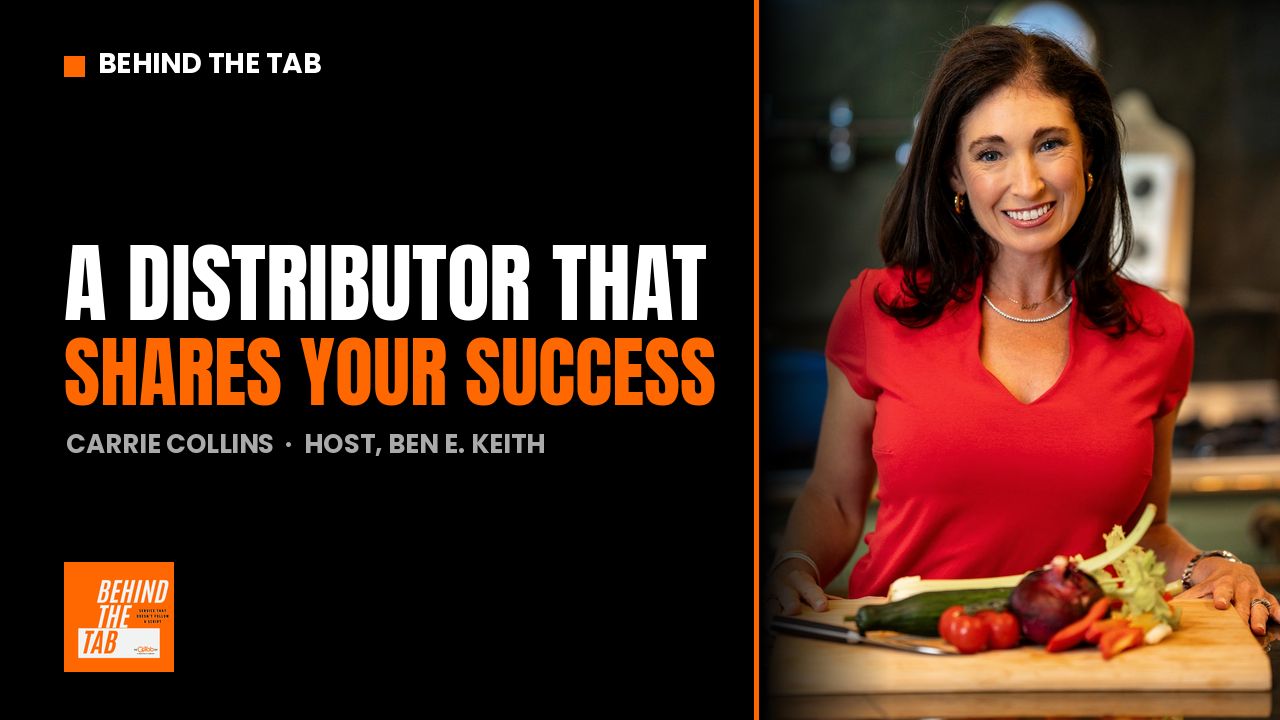
Carrie Collins has spent 16 years at Ben E. Keith — starting as a district sales rep in Lake Charles, Louisiana, back when the company hadn't even built out its Houston division yet. Today she's the corporate director of HOST, Ben E. Keith's program for helping independent restaurant operators run better businesses. Somewhere in those 16 years, she ended up with a front-row seat to something most restaurant technology companies never get to see directly: how an independent operator actually decides whether to trust a new piece of technology.
Her answer wasn't about features. It was about who's doing the recommending.
Is Labor Cost Really Outpacing Food Cost for Restaurants Right Now?
Yes — and it deserves more attention than it's getting. According to data Ben E. Keith pulled from the National Restaurant Association, as of early 2026 nationwide labor cost was running around 37% versus roughly 30% for food cost, a reversal from the pattern most operators are used to. Collins credits part of that shift to operators successfully raising menu prices over the past two years to keep pace with rising food costs — which brought food cost back in line — while labor cost kept climbing regardless. "That labor shortage, that labor cost, and retention" are what she hears operators worrying about most right now, alongside a simpler, older problem: "I need more butts in seats." Food-cost inflation has dominated the restaurant-cost conversation for so long that this shift is easy to miss — but for a lot of operators, labor is now the bigger line item.
That's exactly the pressure GoTab's own platform is built to relieve, and it's the same inversion behind GoTab's guidance on lowering labor costs in fast casual restaurants: not by cutting headcount, but by using mobile ordering, self-service, and kitchen display tools to let a leaner team handle more volume without the guest experience taking the hit. When labor is the cost line growing fastest, the return on technology that gives staff time back — rather than technology that just processes payments faster — gets a lot more direct.
What Does "High Touch and High Tech" Mean for a Restaurant?
It means using technology to create more time for hospitality, not to replace it. Collins puts it plainly: "Hospitality can't be copied by your competitors. It can't be replaced by technology, and it can't be discounted by price." The operators she sees succeeding right now aren't choosing between hospitality and technology — they're using technology to buy back the time and attention hospitality actually requires. "How can technology help me get more time in front of my guest and touching tables?" is how she frames the question operators should be asking. In conversation, she described the restaurants getting this right as high touch, high tech — and reframed here, the point isn't that they're high touch despite being high tech; it's that both have to be true at once. Neither one substitutes for the other, and the restaurants doing both are outperforming their competitors in what she describes as an uncertain market.
That combination is also the design philosophy behind a lot of what GoTab's restaurant commerce platform is built to do — hand off the repetitive parts of ordering and payment so staff time goes to the guest interaction a screen can't replace.
Why Are Independent Restaurant Operators Hesitant to Adopt AI in Their Own Business?
Because the risk feels personal and irreversible in a way that using AI as a consumer doesn't. Collins gives a specific example: independent operators are "very quick to get on ChatGPT" to ask personal questions — health symptoms, random curiosities — but far more hesitant to bring AI into their restaurant, whether that's an AI phone-answering service or feeding their menus and recipes into a tool to see what it suggests. "That is scary for a restaurant operator," she says, in a way that asking ChatGPT about a headache never feels. Her prediction: AI phone answering will follow the same adoption curve as GPS navigation. "In a year, in two years, it's going to be like the Waze app that we can't go two blocks on our own street now without using."
The generational half of the same problem shows up in scheduling: plenty of independent operators are still running their schedule on pen, paper, or an Excel spreadsheet — and the 17- to 19-year-olds they're hiring today have never used Excel and don't want to. Getting a simple, affordable scheduling app into staff hands, Collins argues, isn't just a technology upgrade; it's a retention strategy.
How Does Ben E. Keith's HOST Program Help Restaurants Choose Technology Partners?
By putting the recommendation inside a relationship that already has years of trust built into it, rather than a cold outside pitch. HOST — not an acronym, despite Collins' own team occasionally forgetting that — started roughly 10 to 11 years ago, built by a former restaurant operator on Ben E. Keith's team who recognized operators needed more than food from their distributor. It runs almost entirely through the same district sales reps who already have the customer relationship: "Everything starts with the DSRs, because that is where that relationship is," Collins says. When a customer describes a problem HOST has a vetted answer for, the pitch is unusually low-pressure by design — "I make nothing on it. All I get from this is that you're going to succeed."
That trust-first model is also how GoTab became one of Ben E. Keith's technology partners: Ben E. Keith — the country's fifth-largest broadline foodservice distributor, still privately and family-owned, now serving customers across roughly 25 states from its Fort Worth, Texas headquarters — looks for "shared culture" before adding anyone to the program, and Collins says GoTab checked that box.
What Do Restaurant Technology Companies Get Wrong About Independent Operators?
Assuming operators wake up thinking about technology at all. "When an independent restaurant operator wakes up, they're thinking about their team, their guest. Do I have enough money to meet payroll this week?" Collins says — and for some of the operators she works with, that's not a rhetorical question; they've second-mortgaged their house to keep the business open. Leading with a product's feature list misses that reality entirely. What lands instead, in her experience, is concrete and personal: "This is going to give you back three hours," or "this can bring you $1,000 more to your bottom line" — the kind of plainspoken outcome she's heard attributed to specific GoTab customer conversations, not a slicker description of what a dashboard does.
FAQ
What Is Ben E. Keith?
Ben E. Keith is a privately and family-owned broadline foodservice distributor headquartered in Fort Worth, Texas. It's the country's fifth-largest broadline foodservice distributor, operating across roughly 10 divisions and, as of this recording, serving customers in around 25 states, concentrated across Texas, Louisiana, Mississippi, Alabama, and expanding into North Carolina, South Carolina, Florida, Tennessee, and Georgia.
What Is Ben E. Keith's HOST Program?
HOST is Ben E. Keith's program connecting independent restaurant customers with vetted third-party business and technology solutions — everything from POS systems to labor management to marketing — at no commission to Ben E. Keith. It's run primarily through the company's district sales reps, who already hold the customer relationship.
Is GoTab a Ben E. Keith HOST Partner?
Yes. GoTab's Entertainment Commerce Platform became available to Ben E. Keith Foodservice's customer base starting October 1, 2025, giving Ben E. Keith's restaurant, brewery, and family entertainment center customers access to tools like Easy Tab®, GoTab Pass RFID, and Pocket POS.
Why Is Labor Cost Outpacing Food Cost for Restaurants?
Per National Restaurant Association data Ben E. Keith cited, as of early 2026 labor cost was running around 37% nationally versus about 30% for food cost. Operators raised menu prices over the prior two years to offset rising food costs, which brought that number back down — while labor cost continued climbing, driven by ongoing labor shortages and retention challenges.