




You didn’t set out to build your own dine-in cinema POS. You set out to protect the moviegoing experience. For many dine-in cinema owners and operators, that meant making hard choices early on. Traditional POS systems worked fine at the counter, but they fell apart when service moved into the theater. Mobile ordering introduced glowing screens. QR codes required phones, cameras, and extra steps. None of it felt right for an immersive, dark-room environment.
So operators adapted.
They installed in-seat tablets.
They built custom ordering flows.
They connected ticketing, payments, and food service with APIs, gateways, and manual workarounds.
And for a while, it worked.
If this sounds familiar, you’re not alone—and today, there’s a much bigger upside available than when those decisions were first made.
Why So Many Dine-In Cinemas Built Custom POS Workflows
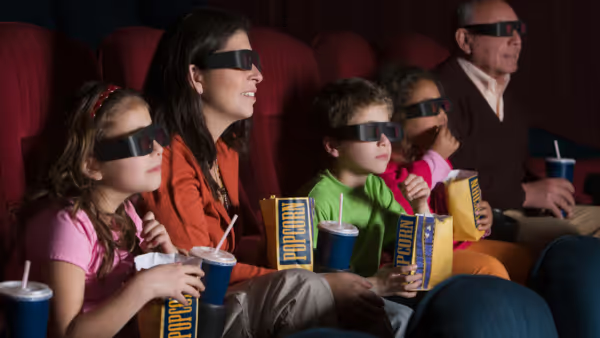
The dine-in cinema model is unique. Guests aren’t just buying tickets—they’re ordering food and drinks while seated, often during a live film. That puts pressure on any dine-in cinema POS to do things most restaurant or theater systems were never designed to handle.
Common requirements include:
- In-seat ordering without visible phone usage
- Secure payments tied to the guest, not just the seat
- Seamless handoff to kitchen, bar, and runners
- Minimal friction once the movie starts
When off-the-shelf cinema POS systems couldn’t support that experience, operators filled the gaps themselves.
The result? Highly customized setups that deliver the right guest experience—but create operational complexity behind the scenes.
Strategic Insights for Eatertainment Venue Leaders
Discover how "eatertainment" venues are transforming hospitality by blending dining, entertainment, and recreation into vibrant destinations. Dive into our guide for strategies to engage and delight your guests.
Download the Guide
The Hidden Cost of a Fragmented Dine-In Cinema POS
Custom solutions solve one problem exceptionally well: protecting the guest experience.
But over time, they introduce others. Many dine-in cinema operators eventually find themselves managing:
- Separate systems for ticketing and food & beverage
- Disconnected reporting between concessions and seats
- Limited flexibility for promotions, loyalty, or memberships
- Ongoing maintenance of a system never meant to scale
None of this feels urgent day to day. Service runs smoothly. Guests are happy. But operational drag builds quietly in the background. That’s usually when operators start asking a different question:
Is there a way to keep the same experience—without managing all this infrastructure?
What a Modern Dine-In Cinema POS Should Actually Do
A modern dine-in cinema POS isn’t about forcing new guest behavior. It’s about supporting the experience you’ve already designed while simplifying everything underneath it. At a minimum, it should:
- Support in-seat ordering without encouraging phone use
- Centralize food, beverage, and payment data
- Reduce the number of systems staff have to manage
- Scale across screens, locations, and service models
- Unlock optional tools like loyalty, rewards, and promotions
This is where platforms like GoTab stand apart—not by replacing your concept, but by acting as the unified commerce layer beneath it.
Why Unified Commerce Matters for Dine-In Cinemas
Most legacy cinema POS systems were built for tickets first, concessions second. Most restaurant POS systems were built for tables, not theaters. A true dine-in cinema POS has to bridge both worlds.
With a unified commerce platform:
- Orders flow through one system—whether placed at a seat, kiosk, or counter
- Payments are tied to people, reducing mischarges and friction
- Kitchen and bar teams work from a single source of truth
- Reporting becomes consistent across the entire operation
Instead of stitching systems together, operators gain clarity and control.
You Don’t Have to Change the Guest Experience
One of the biggest hesitations cinema operators have when evaluating a new dine-in cinema POS is fear of disruption.
- Will guests have to use their phones?
- Will service feel different?
- Will the theater lose its immersive feel?
The reality is the opposite.
The strongest implementations preserve everything guests already love—dark theaters, discreet ordering, seamless service—while removing the operational overhead operators quietly carry.
Fixed tablets, kiosks, staff-led ordering, or hybrid models can all be supported. The difference is flexibility.
Why a Demo Is Where It Clicks
Reading about a dine-in cinema POS only goes so far. The real value shows up in a demo—when operators see their exact workflow reflected back in a simpler, more scalable way.
That’s when questions turn into clarity:
- Can this replace multiple systems without compromise?
- Can it support in-seat ordering the way we already do it?
- Can it reduce reporting and reconciliation work?
- Can it evolve with us instead of limiting us?
For many operators, the answer is yes—and the realization is immediate.
If This Sounds Like Your Dine-In Cinema POS…
If you’ve ever said:
- “We built this because nothing else worked.”
- “Our system functions, but it’s complex behind the scenes.”
- “We want better visibility without disrupting service.”
- “We’ve delayed loyalty or promotions because the setup felt overwhelming.”
Then it’s time to explore what a modern dine-in cinema POS can unlock.
A GoTab demo isn’t about changing how your cinema operates in front of guests.
It’s about removing friction, consolidating systems, and giving you room to grow.
Sometimes the biggest improvement isn’t what the audience sees on screen.
It’s what operators no longer have to manage behind it.
If any of this sounds like your own setup, it’s worth checking whether you’re also seeing these six warning signs it’s time to upgrade your dine-in cinema POS, part of our complete guide to choosing a dine-in cinema POS.
And if this article sounds familiar, that upside is worth seeing for yourself.