





Adam Howe spent eleven years running brewery operations — Pyramid, North American Breweries, Drake's, Upland, Taxman — before joining GoTab, and he built this panel out of six situations he had personally failed to solve at the time. The format was simple: describe the problem, describe the fix he managed back then, and then ask three operators running taprooms today what they would do instead.
The three: Jake Abell, owner and brewmaster at Scuffle Hill Brewing Company in Collinsville, Virginia — a veteran-owned taproom just outside Martinsville, roughly 50 seats inside and 25 out, built around its community. Tom Sullivan, co-founder of Ardent Craft Ales in Richmond's Scott's Addition — about 100 seats inside, another 175 in the beer garden, in its current building since 2014. And Ambar Sharma, co-owner of Route 7 Brewing in Ashburn, Virginia — around 150 seats across a brewing dining area, a kitchen dining area and a mezzanine, plus a 70-seat patio, two years old this month.
Three different sizes, three different service models, one hour. Here is what came out of it.
We asked six operational questions going into this conference. These are the answers the room gave.
- Start the clock at the decision, not the order — the first drink sets everything after it.
- Build the bar like a kitchen — separate the roles instead of adding people.
- Make the tab follow the guest — and if it cannot, make the phone do the finding.
- Communicate the bottleneck before it becomes one — the fix is expectation, not capacity.
- Charge for the membership — an investment behaves differently from a discount.
- Stop relying on a server remembering — build the ask into the workflow.
1. Taproom Speed of Service: Start the Clock When the Guest Decides, Not When They Order
The metric Howe kept coming back to is not ticket time. It is the gap between a guest deciding they want a beer and actually drinking one — which includes every minute before anyone takes the order.
At Drake's Dealership, a 10,000-square-foot beer garden in Oakland, that gap was structural. Full service, but no tableside ordering: a server wrote the order on paper, walked it to a service station and rang it in. The first fix was to hire and schedule dedicated drink runners — not food runners doubling up, a separate role whose only job was carrying drinks from the well to the table. In California, with California labor costs, it still paid for itself. When handhelds arrived and servers could fire from the table, the drink often landed before the server had left it.
Sharma frames the same problem as a time window rather than a seat. His example, which he gives his own staff: when he tells his wife he is going out with the boys, her first question is when he will be back — and the clock starts at the answer, not at the bar. So the taproom's opportunity is not the guest in the chair, it is the two hours they have. Every minute spent waiting on the first drink is a minute taken off what you can sell them. Route 7 also sits next to a children's adventure park, which means a steady flow of parents arriving after three hours of chasing kids, visibly depleted. His staff are trained to go straight to those tables. He describes that single habit as the difference between a guest who thinks the service is bad and one who thinks the place is wonderful.
His method for spreading it is worth stealing. Every taproom has one server who consistently walks out with double everyone else's money. Rather than treat that as a personality, Route 7 turns that person's behavior into the standard operating procedure — greet immediately, bring the menu, bring the silverware, ask if they have been in before — and lets the rest of the floor see it working. They also run no sections: whoever reaches the guest first owns the table, which removes the most common reason nobody moves.
Mobile ordering closes the same gap without adding headcount, and it is the lever most taprooms reach for first. But the panel's point is that it is one of several, and not always the first one to pull.
2. Build the Bar Like a Kitchen: Separate the Roles Before You Add People
Ardent designed its taproom for throughput before it had a throughput problem. Duplicate tap walls, and a bar you can enter from both sides, so bartenders and servers are never queuing behind each other. iPads on the floor, so ordering and closing both happen at the table.
That model held until craft beer exploded and they found themselves four deep at the bar. The obvious answer was a queue, and the obvious risk was that a queue turns a taproom into a cattle line — which would have cost Ardent the thing it actually sells, which is talking to people about the beer.
So they split the queue into stations, the way a kitchen is split. Four people taking orders. Two pouring. One expediter getting each beer to the right person. Two more clearing tables and washing glassware. With four people taking orders, nobody is rushed, so the conversation and the education survive; with two dedicated pourers and an expediter, the line still converts.
Scuffle Hill runs the same principle at a quarter of the size. One main POS, plus mobile devices that come out on busy nights to open extra ordering lanes — in a room that small, a line reaching the door is enough to sour the night on its own. Abell describes working a shift where he is on the POS taking orders and starting tabs while calling drinks across to the bar side, with guests moving through in a wagon-wheel pattern: order, collect, step out of the way, back into the taproom.
Neither venue solved speed by adding staff. Both solved it by making sure no one person is doing two jobs at the moment it matters.
Howe's framing on top of this: there are three kinds of guest in any room — the ones who want to engage, the ones who want to watch, and the ones who want nothing to do with you and are only there because their friends dragged them. A front-of-house team's job is to read which is which and serve accordingly. The same is true of the technology. Some guests will never want to talk to a human, and a lot of guests do. Giving both the option is the point; forcing either is the mistake.
3. Does the Tab Follow the Guest? Roaming Tabs in Taprooms and Beer Gardens
Howe's worst version of this came from a 50,000-square-foot entertainment venue — bowling, arcade, beer garden, several bars, guests in constant motion.
A party books a lane for an hour. It takes them 45 minutes to order. They finally order nachos. Their hour ends, they get moved off the lane, and they drift into the beer garden. The nachos arrive at the lane. The new party there either accepts them — free nachos — or honestly says they did not order them, at which point the food goes back to the kitchen and dies in the window. Twenty minutes later the original party works out they paid for nachos they never got. Either you refund the tab or you refire the order. Both ways you lose the nachos.
Two things would have fixed it and neither existed: a tab that moves when the guest checks in somewhere new, or a text when the order is ready.
Every operator on the panel deals with a version of it.
At Route 7, guests order at the bar, then decide the weather is too good to waste, or find the couches on the mezzanine, or get joined by friends — and the food arrives downstairs. Sharma's workaround is a tell rather than a system: every section is numbered, and staff upstairs are trained that anyone arriving with a drink already in hand has an open tab, so ask and transfer it to the new table. For car shows, when hundreds of people are outside, they hand out numbers.
Ardent is more relaxed about it by design — order at the bar or from the table, no servers monitoring sections, and about 15% of guests choose the table. On busy days they hand out flags, and Sullivan is candid that on a big night with a party spread across tables in the beer garden, someone is still walking around looking. It is not perfect, and he does not claim it is.
Scuffle Hill is designing the problem out of a location that does not exist yet. The new site has a pizza kitchen going in, and the plan is text-to-order with numbered tables, so a guest gets the bartender interaction they came for, sits down, and orders the pizza later from the table when they are ready. Abell's reasoning is that the most valuable asset every guest already carries is a phone — ping it, and they collect the food inside 60 to 90 seconds, while it is hot. The table number is the fallback for anyone who has wandered into the field outside.
A tab the guest opens once and carries with them — Easy Tab — removes the location dependency rather than working around it. But the panel's practical consensus is worth stating plainly: flags and numbered sections are a search, and a phone is an address.
The part everyone forgets: how the tab closes
Howe pivoted mid-scenario to ask how each venue handles the close, on the grounds that paying is the last thing that happens to a guest and almost nobody designs it.
Scuffle Hill pre-authorizes. Tap or insert to open, card on file, and every beer added to the tab pings the card, so the venue knows the money is there for the drinks plus the default 20% tip before the guest walks anywhere. Guests are still encouraged back to the bar to close, mostly so they can check the tab for mis-rings — but if someone leaves, the bartender is covered and so is the venue.
Ardent asks at the point of order whether the guest wants a tab. Anyone who ordered from the table can close from their phone. Anyone who walks gets picked up by automatic end-of-night reconciliation with gratuity added.
Route 7 deliberately keeps a person in the close, because Sharma treats it as the venue's best and last chance to ask how the visit went and to ask for a review. That is a service decision, not a technical limitation, and it is the right one for a full-service room.
4. Where Is Your Production Bottleneck — and Does Your Kitchen Display System Show It in Time?
Drake's Dealership again: 275 seats, a menu built around New Haven-style pizza, a wood-fired oven that turns out a single pizza in under five minutes. The oven was not slow. The oven was finite.
On a Friday night, with most of a 275-seat room ordering pizza and every table's food expected to land together, ticket times hit 45 minutes. There was no kitchen display system — paper tickets, a chef losing them off the rail, and eventually the chef shouting that he could not take any more orders, which is the one sentence a general manager on the floor cannot repeat to the room.
The real failure was not capacity. It was that nobody found out until they were already 45 minutes deep. By then you are putting out a fire instead of preventing one.
Sharma splits this into two problems, and the split is the most useful thing in the section.
First, find the bottleneck with data you already have. The POS tells you volume. The expo or KDS screen tells you delay. Cross the two and the constraint identifies itself. Route 7 ran exactly that analysis, found the fryer, and added a second one. That is a capital fix, and it was the right one — but they only knew where to spend because they had measured.
Second, communicate it at the point of sale. What Sharma wants, and has not found, is item-level status on the ordering screen: chicken skewers showing green, amber or red, so a server taking an order can say the skewers are running 40 minutes and offer the wings instead. Either the guest switches, or they order the skewers knowing exactly what they signed up for. The expectation gets set at the only moment it is free to set.
A kitchen display system that surfaces live prep times to the floor, and lets you delay or batch, is where most operators start on the second half of that.
Ardent's answer is to have designed the problem out. The hot food is not theirs to manage — a restaurant operates alongside them on its own point of sale, sharing the seating and the beer bar. Ardent runs a short concession menu under its own license — pretzels, beer cheese, meatballs — food it can reheat, slice and assemble rather than cook, on a single Turbo Chef with one cook, at roughly two minutes an item. There is rarely a backup, and anyone who wants a hot meal walks to the restaurant. The food also exists for a licensing reason: a few thousand dollars a month in food sales is what keeps the wine and cider license. Low waste, low prep times, no bottleneck to manage.
Scuffle Hill, planning its pizza kitchen, floated a Friday and Saturday special — one lower-priced pizza, dough rolled and ready that morning, to concentrate demand on the fastest thing to produce.
Howe pushed back on it live, and the exchange is the most useful sixty seconds of the hour: do not add operational complexity to your busiest service. Keep Friday and Saturday simple. Put the specials on Sunday or Monday, when you actually want to drive traffic. Abell took the point.
5. Should Every Zone Get the Same Menu? Using Order Zones to Manage Capacity
The other half of Howe's pizza-oven fix was to stop selling pizza in about a third of the building on the busiest nights. Order a pizza in the bar area and you could not — you waited until you were seated in the dining room. They also stopped selling pizza for takeout on Friday and Saturday nights entirely.
Operationally it worked. The cost is entirely on the guest-facing side, and it is real: someone in the bar can see a pizza being carried past thirty feet away and cannot order one. That needs direct, unembarrassed communication from the floor, and you will still take some backlash.
Sharma wants this and does not have it. He has asked twice — once at opening, once during a car show with six hundred people outside the brewery — to cut the menu down for the rush, and both times was told it was covered. He has not pushed it further.
Which produced the line Howe said he had heard three separate times before lunch on day one of the conference: the limitation is almost never the technology. It is what the staff are willing to adopt — the procedures as much as the software.
Scuffle Hill is looking at ordering by section in the new space — pizza only from a table, small bites only at the bar — as a way to hold prep times down. Whether it survives contact with Howe's advice about complexity on a Friday is an open question, and the panel left it open.
Order zones and location-specific menus are the mechanism. The decision about whether to use them is a staffing and communication decision first.
6. Is Your Membership Program Actually Creating Loyalty — or Just Giving a Discount?
Howe ran a membership at Upland Brewing built entirely on the sour program: the beers were scarce, you could only get them at one of four taprooms across Indianapolis, Columbus and Bloomington, and drops were quarterly. Members drove from Chicago and Louisville four times a year.
Then the sours reached retail shelves.
The detail that matters is what happened next. Membership numbers did not fall first — member interaction did. People kept paying and stopped coming, which is the state right before they cancel. Upland rebuilt the program around the taproom itself and the local neighborhood, which both moved revenue to where taproom revenue actually comes from and gave them control over the experience, since everything a member now valued happened inside their four walls.
Scuffle Hill invested in a membership platform after last year's conference and built the Mug Club — rewards redeemed in the app: a dollar beer weekly, a free four-pack monthly, a quarterly bottle drop. Members pay in, and Abell is precise that they still experience it as a benefit rather than a purchase.
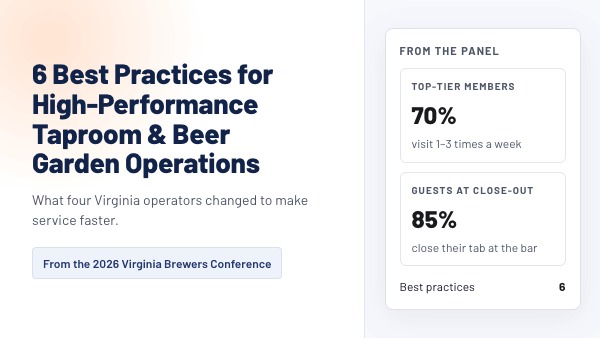
Then he produced the number of the hour. In the top tier — the people he calls the super fans — 70% are in the taproom between one and three times a week, in a venue open seven days.
They do not collect the reward and leave. The taproom runs like an episode of Cheers: a member comes in for the dollar beer, finds a regular at the bar, and three beers later is still there. The dollar beer is not the transaction. It is the reason for the visit that contains the transaction.
Howe's observation on that: Abell used the word discount once in several minutes. Paying into a membership creates investment, and investment behaves differently. The comparison he drew was a streaming subscription — you pay whether you watch or not, and the moment you notice you are not getting value, you cancel. A membership someone pays for is one they will use to justify having paid for it.
His other recommendation is the one most mug clubs get wrong: let members use their benefits for the people they bring. If a member gets dollar pints, let them buy dollar pints for the table. A member who walks in with eight non-members has generated eight people you did not have, and a club aimed only at the regulars who were coming anyway has not generated anyone.
Sharma's addition is that the program is not really a rewards mechanism at all — it is a data relationship. Knowing how often someone comes and what they drink turns a customer into a patron. If the numbers show a member's Wednesday spend running higher than every other day, you have learned they are a trivia-night regular, and you can do something with that.
And Howe's closing point, which costs nothing: exclusivity works where a discount does not. One tap reserved for members — visible on the board, no discount, members simply have the right to buy it. A secret menu of two or three chef's-choice items made in limited quantities, members only. Nobody saves money. Everybody wants in.
Whatever shape yours takes, the question underneath any loyalty or membership program is which behavior it is designed to produce. If the honest answer is "a discount," there is a bigger opportunity in the room.
7. What Still Depends on a Server Remembering? Building the To-Go Ask Into the Workflow
Upselling is not a technique. As Howe put it, it is service 101 — the whole of it is asking. Do you want a six-pack. Do you want the retail beer. Operators have been doing it since restaurants existed.
The problem is that it depends on a busy person remembering, and busy people forget.
Sharma's fix is in two parts, and the first is the same principle he applied to greeting: take what the best server does at the close — mention the merch, ask for the review — and make it the standard, not a talent. The second part is to stop relying on memory at all. What he wants from a handheld is a workflow trigger: this table has been here two hours, ask about cans to go, ask about merch, ask for a review. The prompt does the remembering, and the server does the asking.
Howe's version from the floor was lower-tech and very effective: when the bar had a spare minute on a Saturday, a bartender poured a tray of two-ounce samples and the runners handed them out. The guest tries something they did not order, likes it, and learns — conveniently — that it also comes in cans.
Sullivan was straightforwardly honest about where Ardent is: old school, reinforced at staff meetings, and probably asked about half the time. Not something they are good at, and something they know they could improve.
Howe's response to that is the argument for doing anything about it at all: if 85% of your guests come back to the bar to close out, you have an opportunity standing in front of you 85% of the time.
The best answer of the session came from Abell, and it is about attention rather than scripts. Scuffle Hill had a beer tender named Levi who was extraordinary at this — Abell says he could use the identical words and get a no, and Levi would sell a case. What Levi actually did was pay attention. He noticed a guest had been drinking blonde ales all afternoon, and at close-out offered to grab a few cans from the fridge. He noticed someone looking at the merch wall, and mentioned that the hoodie he was wearing was pretty good for the cold outside. Four cans out the door, every time.
After Levi left, what they taught the rest of the team was not his phrasing. It was the noticing: track what the guest in front of you actually drank, and make the offer specific to it. In a room with seventy people in it, an offer that proves someone was paying attention does not feel like a sale.
Which is the balance the whole hour kept circling. Technology can make sure the opportunity does not disappear when the room gets busy. It cannot notice that the guy at the end of the bar has had three of the same beer and would probably take four home. Automate the remembering. Leave the noticing to your staff, and give them the time to do it.
The Through-Line
Six scenarios, four operators, three venue sizes, and the same answer underneath most of them: the constraint is rarely the equipment.
Ardent's queue problem was solved by splitting roles, not buying anything. Route 7's greeting standard came from copying a server who was already doing it. Scuffle Hill's best upsell was one employee who paid attention. Sharma's honest account of why Route 7 has no zone menus is not that the software cannot do it — it is that the team has not adopted it. And Howe, who now sells the technology, spent a fair portion of the hour saying that a genuine recommendation from someone who knows the beer beats an automated prompt every time.
The technology is worth having where it does the thing people are bad at: remembering, measuring, finding a guest who moved. The rest is still the job.
Thanks to Jake Abell of Scuffle Hill Brewing, Tom Sullivan of Ardent Craft Ales and Ambar Sharma of Route 7 Brewing for an hour of unusually candid answers, and to the Virginia Craft Brewers Guild for the session. If you want to talk through any of the six in your own room, that is what we do.