





At a Glance
Business: The Blind Horse Restaurant & Winery
Footprint: Kohler and Cedarburg, Wisconsin
Revenue streams: Wine production, fine dining, tasting rooms, bistro patio, wine club, private events, catering
Previous systems: Three — OrderPort (×2), Aloha (×1)
Now running: GoTab POS and handhelds, with Fishbowl by GoTab and opsi by GoTab
Implementation: Approximately 90–120 days in, as of September 2026
What The Blind Horse Needed From a Multi-Unit POS
- One operational view across two locations, several service styles and five revenue streams.
- A system that could run a casual tasting-room ticket and a five-course fine-dining service.
- Connections among transactions, guest data, recipes, costs and wine inventory.
- Less manual invoice entry, and traceability from delivery to pour.
- An open platform that keeps adapting as the business expands.
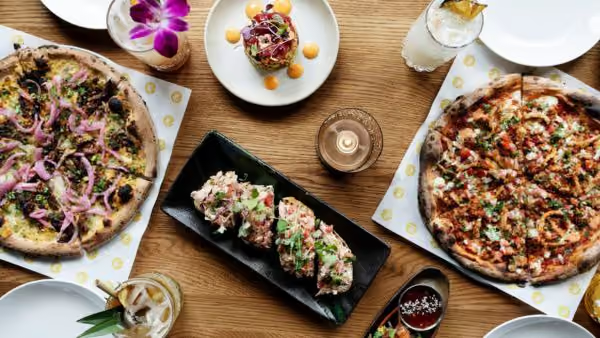
At The Blind Horse, guests do not experience the business in neat categories. They may start with a tasting, order an appetizer and follow the live music to the terrace for dinner. Later, they might move to the patio or restaurant for another drink.
That freedom is part of the appeal. It is also what makes the operation difficult to define with a conventional restaurant system.
“We are a boutique winery, a manufacturer, an event space, a fine-dining restaurant and a tasting room. We also handle catering and prepare meals for airport and airline clients, so there are many different facets to what we do.”
— Jason Bagan, sous chef, The Blind Horse, previously more than 20 years in information technology
What Is a Multi-Unit POS, and When Does One Property Need One?
A multi-unit POS is a single point-of-sale platform that runs more than one location, revenue center or service style from one shared configuration and one reporting layer — rather than a separate system per site. Operators usually need one at the point where the same guest, product or report has to cross a boundary that their current systems treat as a wall.
For most restaurant groups, that boundary is geographic: two locations, two systems, two sets of numbers to reconcile. The Blind Horse hit it from an unusual direction. It reached the limit inside a single property, long before the second location existed.
What Happens When One Property Becomes Five Businesses?
The Blind Horse grew into its model one experience at a time. Its Kohler property dates to 1862 and takes its name from Birdy, a blind Percheron draft horse that once worked the land. The modern restaurant opened in 2012, followed by the winery and patio in 2014 and The Granary event space in 2018. The Blind Horse Cellar expanded the concept into Cedarburg in 2025.
Each new space created another reason for guests to return. Each also brought its own service pace, reporting needs and inventory demands.
Before GoTab, the winery ran on OrderPort, a specialized system that supported wine sales, shipping and related tax requirements. The restaurant and patio used separate Aloha environments. Cedarburg required another OrderPort instance.
Three point-of-sale systems. One business.
That is the shape of the problem a multi-vendor and multi-revenue-center platform is built to solve — and it is worth noticing that The Blind Horse arrived there without ever setting out to become a restaurant group.
Can One POS Run Quick Tasting-Room Tickets and Coursed Fine Dining?
The limitations became most visible in the kitchen.
A tasting-room or patio ticket could follow a first-in, first-out workflow. Order, fire, serve. A restaurant dinner might unfold across five courses, each released to the kitchen at a different time, paced to the table rather than to the queue.
Most systems are built for one of those. Asking a wine-sales platform to run coursed service is asking it to do something it was never designed for.
“We tried to go strictly to OrderPort for all locations, but it was not capable of handling the fine-dining side. Then we added another restaurant system and another instance for Cedarburg. We went from having two point-of-sale systems to having three.”
— Jason Bagan
This is the specific capability gap that adds systems to an operation. A platform that supports server coursing — where staff control when each course fires, per table — can run the tasting room and the dining room on the same configuration. One that cannot will always need a second system beside it, and a third once a second location opens.
The Blind Horse had outgrown a patchwork of software, with each system addressing only one part of the operation. Bagan was tasked with finding a more connected solution. His search led to GoTab.
How Do You Evaluate a POS for a Multi-Unit Operation?
Bagan did not begin his search by comparing button layouts or hardware packages.
His IT background led him deeper into the architecture of how things flowed. He examined how each platform handled separate revenue centers, how easily data could move and whether the system could connect with the specialized tools a winery and restaurant needed. He also looked at the quality of the API documentation — an early indication of how seriously a provider treated integrations.
Four things he checked that most POS evaluations skip:
- Whether the architecture assumes one revenue center or many. GoTab’s ability to support shareable tabs across connected environments first earned his attention. The Blind Horse does not yet use every tab-sharing capability, but the architecture suggested that GoTab understood businesses where guests, orders and revenue move across more than one service area.
- The quality of the API documentation, as a proxy for how seriously the vendor treats integration.
- Which specialized tools already integrate — for a winery, that means inventory, compliance and guest-marketing platforms, not just accounting.
- Whether reporting can be modified. When Bagan asked an incumbent provider to change a report, he was told the available reports were the only options. That answer revealed the larger problem: The Blind Horse was trying to fit an evolving operation into rigid technology.
“I started digging into GoTab and noticed the shareability of tabs across multiple venues. If it could work across multiple food businesses, it could work across different revenue streams. Then I saw Fishbowl, opsi and the other integrations. I looked at the whole API layer, and the documentation was very straightforward. GoTab was integrating with a lot of different platforms, so it was worth a serious look.”
— Jason Bagan
The value was not any single feature. It was the possibility of making the platforms operate as one connected system.
How Does a Winery Track Inventory From Invoice to Pour?
The Blind Horse began using GoTab handhelds in its Kohler tasting room and Cedarburg location, allowing staff to serve guests without pulling them away from the experience. Team members can also email a tab for immediate payment, which gives them another way to close a check when guests are moving through the venue.
Behind the transaction, opsi addresses one of hospitality’s least glamorous jobs: entering invoices.
Its AI-supported invoice processing reads invoices and packing slips before staff review the results. The system does not eliminate oversight, but it can remove much of the line-by-line typing required to build accurate cost and inventory records.
“It is not going to pick every category and every item correctly, so you do have to go back through it. However, you do not have to type everything in. You do not have to sit and go line by line through 30 invoices or packing slips to make sure every weight and measure is entered. That is very tedious, and nobody wants to do it.”
— Jason Bagan
The data continues into production and service. The Blind Horse can associate a product with a recipe, distinguish a 3.5-ounce pour from a 1.25-ounce tasting and track the volume sold through the POS across its locations.
That level of detail carries added importance for a wine manufacturer. Once a bottle leaves the warehouse, the team must document where it went and account for state, federal and interstate requirements. Connecting opsi inventory data with GoTab transactions gives The Blind Horse a clearer path from product movement to final sale — the same path a compliance question has to be answered along.
It is the kind of requirement that separates a winery from a restaurant, and the reason a general-purpose POS and a restaurant management platform integration have to work as one.
What Changes When the POS, Guest Data and Inventory Are Connected?
Fishbowl by GoTab adds the guest and analysis layer. The team plans to use Fishbowl for wine club communications and membership management while examining GoTab transaction data through views tailored to different roles.
“With the integration between Fishbowl and GoTab, we can see in the blink of an eye what our average check was for an entire month. The reporting inside GoTab is cohesive, and the data-mining side of Fishbowl gives us an even greater look. Each person needs a different view, and those views are easier to access across the three platforms.”
— Jason Bagan
That connected flow is the practical advantage of the combined stack. The transaction no longer has to end at the POS. It can inform how the business markets to a guest, accounts for a pour, traces a bottle and evaluates performance — across two locations and five revenue streams, in one place.
How Long Does a Multi-Unit POS Implementation Take?
The Blind Horse was approximately 90 to 120 days into its GoTab implementation when Bagan discussed the transition — a realistic window for an operation replacing three systems across two locations, with wine production, compliance and fine-dining service all in scope.
At that stage, responsiveness mattered as much as the feature set.
Bagan said the GoTab, Fishbowl and opsi teams moved quickly on reporting questions, inventory configurations and integration issues, shortening the lag between identifying a problem and putting a solution into practice.
“Normally, when you deal with software companies, you wait days to get a bug fixed. Here, we can bring up a problem or something we need and hear, ‘Yes, that is fixable.’ Then 10 minutes later, it is done. The speed at which the technical teams have been able to modify, integrate or clean up what we need has been monumental.”
— Jason Bagan
Speed, however, does not mean adopting every capability at once. The Blind Horse remains a white-glove operation. Bagan wants to complete the wine club integration before introducing QR ordering, ensuring the technology supports the service model instead of dictating it.
The longer-term roadmap includes easier digital identification for wine club members, more seamless card-on-file payments between Fishbowl and GoTab, and a guest Wi-Fi portal designed to capture useful customer data.
“We are pushing to use as much as possible, as quickly as possible, so it does not drag on. When an implementation drags on, people get bored and stop using it. The beauty of GoTab, Fishbowl and Opsi is that their teams are persistent about getting their tickets done. They have kept me on point.”
— Jason Bagan
That last point is worth sitting with, because it inverts the usual advice. The risk in a multi-unit rollout is not moving too fast. It is moving so slowly that the staff stop believing in it.
Technology That Adapts to the Operation
The Blind Horse did not set out to replace hospitality with technology. It selected a stack capable of understanding how its hospitality business actually works, then adapting as that business continues to grow.
Bagan sees that expansion as part of a broader commitment to keep raising the guest experience.
“As we grow, whether it’s wine production or food, we’re exploring every avenue. The elevation of the food and the elevation of the wine just keep increasing as time goes on.”
— Jason Bagan
Bring Every Part of Your Operation Together
Running a complex hospitality business across multiple locations, service models or revenue streams? GoTab connects transactions, guest data and inventory — giving your team a clearer view of the operation and more freedom to grow. Visit GoTab.com to request a demo today.