




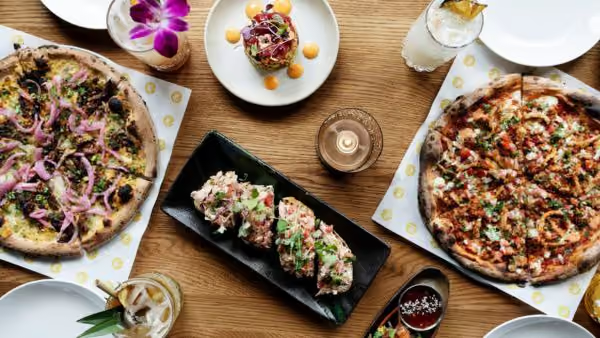
Chef Curtis Dettman built Pau Hana’s kitchen from day one.
The restaurant began with a vision its owners carried from Hawaii to Minnesota. After living on the islands, they wanted to recreate the food, hospitality and cultural mix they experienced there. Dettman turned that vision into a working kitchen centered on Hawaiian dishes such as loco moco and the blend of influences that defines island cuisine.
He also guided the restaurant through an opening that collided with the COVID-19 pandemic.
Pau Hana weathered that uncertainty and built a following. The restaurant in Savage, Minn., now serves between 300 and 400 guests on a busy Friday night. Some diners arrive in Hawaiian shirts and talk about upcoming island vacations.
“It’s definitely a destination spot,” Dettman said. “People will say, ‘I’m going to Hawaii next month,’ and they show up with all their Hawaiian gear.”
Dettman had opened restaurants before, but he usually moved on after the launch. Pau Hana became the first concept where he stayed long enough to shape what came next.
He recently moved from executive chef to director of operations for Pau Hana and Lake & Irving in Uptown Minneapolis. The promotion expanded his responsibility from one kitchen to two restaurants located about 30 minutes apart. His commute from home takes more than an hour.
Dettman cannot be on the line at both restaurants, inspecting every plate or answering every question in real time. The distance between the locations makes it essential that his standards remain consistent, even when he is not physically in the kitchen.
“You can’t replicate yourself,” said James Passafaro, co-founder of opsi and VP of Restaurant Operations and Strategy at GoTab. “Curtis has to be in two different places all the time, and his brain also can’t be everywhere.”
Opsi gives Dettman a way to place recipes, preparation methods, allergy information, ordering processes and food costs directly into the hands of his teams.
“I’m very much a systems person,” Dettman said. “I have a wall of clipboards, and that’s where everything lives. Now the wall is on the phone that everyone has.”
With opsi, instead of carrying the operation in his head or in a printed binder, Dettman can build standards his teams can follow wherever he happens to be.
That visibility has delivered a measurable financial return, too. Dettman used opsi to identify and recover approximately $5,000 in vendor overcharges – enough to cover roughly a full year of the platform’s cost. The app also uncovers hidden recipe costs, improves training and maintains consistent standards across multiple restaurants.
How opsi Powers Pau Hana’s Operations
Opsi connects kitchen operations, inventory, costing and accounting in one restaurant management platform. Restaurants using opsi save an average of $15,000 per location each year and reduce training time for new cooks by 80%.
At Pau Hana, Dettman uses the platform to connect front- and back-of-house workflows, track costs and give his team of about 40 employees one reliable source for recipes, prep and operational information. Here’s how opsi supports the operation:
- Centralizes more than 300 recipes, preparation methods and kitchen procedures
- Gives front- and back-of-house teams immediate access to recipes, ingredients and allergy information from a phone or tablet
- Builds prep lists and par levels based on what the kitchen has on hand
- Supports vendor ordering, invoice processing and price tracking across multiple suppliers
- Reveals the full cost of each dish and drink, including garnishes, straws, custom ice and salt rims
- Tracks waste, purchasing changes and recipe updates so managers can identify problems quickly
- Allows Dettman to maintain consistent standards across multiple restaurants, even when he is not on the floor
A Born-Again Restaurant Technologist Builds a Smarter Kitchen
Chef Dettman knew something was wrong when a new cook prepared a pizza without the bacon the dish required. The cook pulled up opsi on his phone and showed him that the ingredient was missing from the documented recipe.
“At that point, I couldn’t even be mad,” Dettman said. “That was on me, not him.”
The cook had followed the instructions exactly. Dettman quickly corrected the recipe. The moment showed how much his approach to kitchen systems has changed.
Dettman and Passafaro first worked together at Spoon & Stable in Minneapolis. Passafaro later introduced him to opsi by placing a digital prep list at his station and telling him to use it.
“Then we got into a little fight,” Dettman shared with a laugh. Passafaro now calls him a “born-again technologist.”
Dettman had always relied on systems, just not digital ones. Paper recipes, handwritten adjustments and rows of clipboards kept his kitchens organized. As menus changed and teams grew, however, a single recipe could collect a dozen revisions. One cook might follow the original measurement while another worked from a handwritten note that changed it to tablespoons.
Opsi gives the team one consistent source for recipes and procedures. Employees no longer have to locate the right clipboard, interpret handwritten changes or wait for Dettman to answer a question. They can pull up the information from the line or prep station.
That access matters at Pau Hana, where Dettman estimates about 90% of the kitchen team speaks Spanish as their first language. Even with limited English, they can open recipes on their phones and use translation tools to review the instructions.
“They take a screenshot, translate the recipe and say, ‘I can make this now,’” Dettman said. “And I tell them, ‘Perfect!’”
Pau Hana’s Purchasing Manager Vero, one of the restaurant’s standout employees, speaks no English and uses opsi to place orders with three different vendors.
“She’s a star player,” Dettman said.
Passafaro describes the approach as “weaponizing the phone.” Instead of viewing phones only as distractions, Pau Hana turns them into working tools that place recipes, procedures and ordering information directly into employees’ hands.
The platform does not replace Dettman’s judgment or his responsibility to train the team. It makes his standards easier to find, follow and correct. When the pizza recipe omitted bacon, the cook could show that he had followed the documented process, and Dettman could fix the source of the mistake.
Dettman is building a kitchen where employees do not have to carry every instruction in memory and the operation does not stop when he leaves the floor.
How opsi Uncovered A $5,000 Vendor Overcharge – And Paid For Itself
Opsi also gives Dettman a clearer view of where the restaurant is losing money. Soon after stepping into his new role, he reviewed vendor invoices through the platform and noticed a pricing change that did not match the restaurant’s agreement. The discrepancy had continued for more than a year.
“I noticed the graph and thought, ‘That’s not right,’” Dettman said.
The vendor later confirmed the error and acknowledged that they owed Pau Hana about $5,000.
“I would have never caught it,” Dettman said. “That was my biggest achievement with opsi so far.”
The recovery covered roughly a year of the platform’s cost, but the same visibility also sharpened Dettman’s everyday decisions.
When he entered Pau Hana’s bar menu into opsi, he found that earlier calculations included the liquor and syrup but left out smaller items such as flower garnishes, straws, custom ice and salt rims. Those overlooked details added about 40 cents to some drinks and pushed actual costs above the restaurant’s targets.
Opsi also allows Dettman to track waste and unusual purchasing activity. He can see when the kitchen discards too much tuna, when an ingredient price jumps or when a large order reflects a private event rather than routine demand.
The platform turns those numbers into questions Dettman can act on. Instead of discovering a margin problem at the end of the month, he can identify where it began and work with the team to correct it.
Building an Operation that Can Run Without Constant Chef Oversight
By the time Dettman gets home, he has already traveled more than an hour from the restaurants. A day spent visiting both Pau Hana and Lake & Irving can put him on the road for nearly three hours.
His responsibilities also extend beyond restaurant operations. Dettman is an entrepreneur with his own business interests and a full life waiting at home. Like many chefs who move into senior leadership, he must balance the demands of the kitchen with the financial, operational and personal responsibilities that come with running several venues.
“There’s no way I can keep everything in my head, especially while overseeing two restaurants,” Dettman said. “I also run an eBay business from home and take care of farm animals. There’s a lot going on.”
Opsi allows the operation to travel with him. From home, Dettman can review recipes, monitor costs and guide his teams without making another trip to the restaurant. When an executive chef sends him the numbers for a potential steak dish, Dettman can review the cost percentage and recommend changes before it reaches the menu.
That access gives him more time to lead instead of constantly reacting. It also positions the restaurant group for its next stage as the team develops Pau Hana Express and considers additional growth.
“Some chefs resist technology, but no one can remember every detail,” Dettman said. “Now, when someone asks what goes into a dish, I can pull it up and give them the exact answer.”
For Dettman, that is the clearest measure of scale. He no longer has to stand in every kitchen to keep his standards there.
“For me, opsi takes away the pressure of having to remember everything,” Dettman explained. “We have more than 300 recipes in the system. Whether I’m onboarding a new cook, training a front-of-house employee on allergens or managing another restaurant, the team can find the information without waiting for me. It makes training easier, gives everyone the same source of truth and allows the operation to keep moving.”
Key Takeaways
Venue: Pau Hana, Savage, Minnesota
Concept: Hawaiian-inspired restaurant built around traditional dishes, island hospitality and the cultural mix that defines Hawaiian cuisine
Leadership: Curtis Dettman, director of operations for Pau Hana and Lake & Irving and former executive chef at Pau Hana
Operational Scale:
- Serves approximately 300 to 400 guests on a busy Friday night
- Employs roughly 20 kitchen team members and 20 front-of-house employees
- Manages more than 300 recipes and kitchen procedures in opsi
Opsi Implementation: Pau Hana has used opsi since opening. Dettman is also introducing the platform at Lake & Irving, beginning with liquor ordering, beverage recipes and food costing.
opsi Tools Used:
- Digital recipe and procedure management
- Mobile access for kitchen and front-of-house teams
- Ingredient and allergy information
- Automated prep lists and par levels
- Vendor ordering across multiple suppliers
- Automated invoice processing and price monitoring
- Live food and beverage costing
- Inventory and waste tracking
- Recipe edit history and operational accountability
- Remote access across restaurant locations
Business Impact:
- Identified and recovered approximately $5,000 in vendor overcharges that had accumulated over more than a year
- Revealed about 40 cents in previously uncounted costs per cocktail, enabling more accurate pricing and stronger margins
- Reduced the time managers spent manually reviewing and entering invoices
- Provided non English-speaking kitchen team easier access to translatable recipes and procedures
- Gave front-of-house employees direct access to allergy and ingredient information
- Created a scalable operating foundation for Pau Hana Express and potential future concepts
Why It Works: opsi turns Dettman’s knowledge into a system his teams can use whether he is on the line, working at another restaurant or more than an hour away. By connecting recipes, training, ordering and cost controls, Pau Hana can maintain consistent standards without requiring one chef to carry every answer.
Join the Free Webinar on August 18
A great kitchen culture cannot live in one chef’s head. Join Curtis Dettman of Pau Hana and James Passafaro of GoTab for a practical conversation about building more consistent kitchen operations without sacrificing creativity or culture.
How Chef-Driven Restaurants Scale Without Losing Their Culture
Aug. 18 at 12:00 p.m. ET
Learn how chef-driven restaurants can give their teams the information they need while giving chefs more time to lead.
Register for the free webinar.