





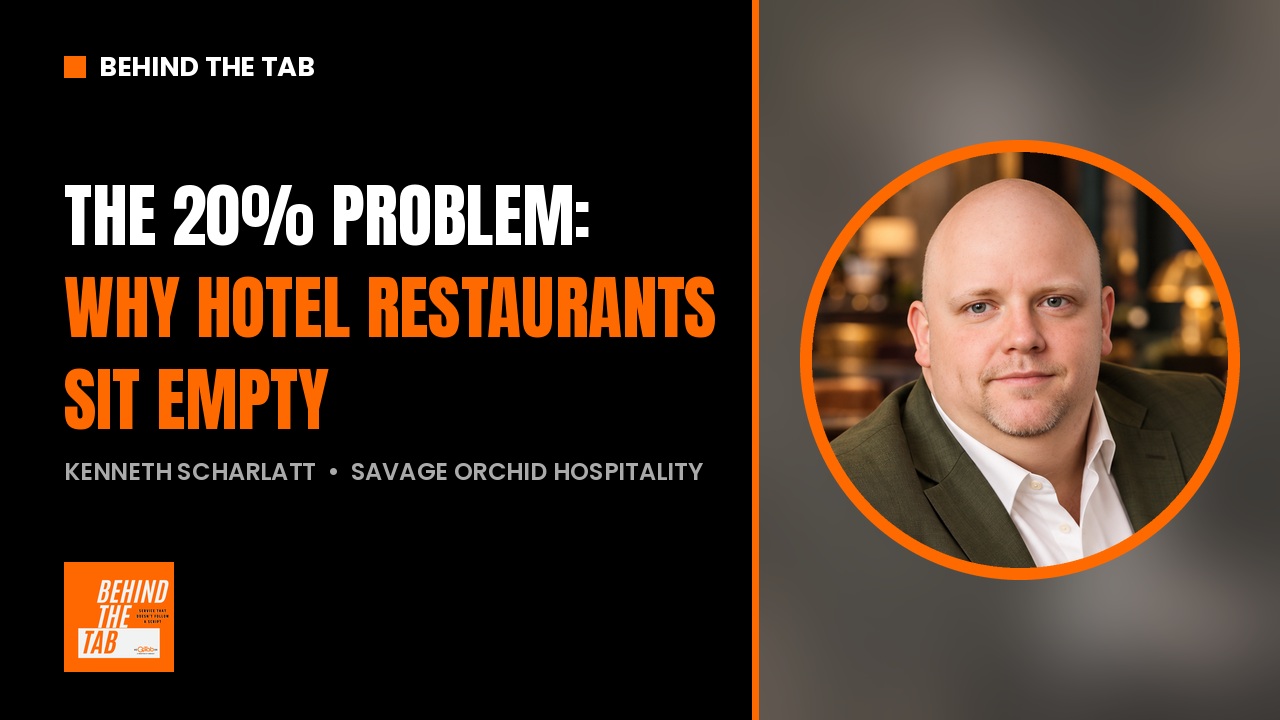
Listen to the full conversation on Spotify.
Fewer than 1 in 5 hotel guests dines in-house beyond breakfast, according to hospitality consultant Kenneth Scharlatt. Here is what operators can do about it.
Hotel restaurants are beautiful, well staffed on paper, and often strangely quiet. Kenneth Scharlatt, founder and executive director of Savage Orchid Hospitality, has a simple explanation: most hotel restaurants are run as an amenity for the people upstairs, so they depend on a small slice of in-house guests to fill the room.
Kenneth is the first returning guest on Behind the Tab. When he first joined us in February, we talked about rethinking the hotel restaurant. This time he brought the argument behind his upcoming book, Stop Calling It an Amenity, along with what he has learned speaking at restaurant and lodging shows across the country. Here are the lessons operators can use.
Why Do Hotel Restaurants Struggle to Fill Seats?
Because they rely on the people staying in the building. Kenneth cites an American Hotel & Lodging Association statistic that fewer than 20% of hotel guests use a hotel's food and beverage outlets for anything other than breakfast.
He turns that into arithmetic: if 200 people are staying at your hotel on a given night, fewer than 40 of them will visit your restaurant for anything other than breakfast. Spread those diners over a five-hour stretch and the room feels empty.
"If only 40 people are coming into your restaurant, you're not even getting a half of a turn." — Kenneth Scharlatt, on an 80 to 100 seat hotel restaurant
The staffing follows. With that little traffic, operators schedule a server and a bartender who also takes tables, and skip the host.
"It's the definition of working on a skeleton crew." — Kenneth Scharlatt
An empty-feeling room then becomes its own problem, because almost nobody wants to eat in one. Kenneth's point is that this is not a new failure. It is how hotel food and beverage directors have operated for decades: convenience for guests upstairs, and nothing more.
"It never really dawned on me that the hotel or the hotel restaurant was only there to serve the hotel guests." — Kenneth Scharlatt, on moving into hotels from independent restaurants and nightlife
How Much Revenue Can a Hotel Restaurant Add?
In Kenneth's view, a lot. He says owners and asset managers have largely capped out on what they can charge for rooms and are chasing ancillary revenue such as parking and resort fees. Food and beverage, he argues, is the biggest source that gets forgotten, and the space already exists.
"People are always forgetting that food and beverage, it's a way to drive an enormous amount of ancillary revenue." — Kenneth Scharlatt
His estimate is that a restaurant can go from roughly breaking even, around a couple hundred thousand dollars in revenue, to $1.5 million or $2 million. That is his experience as a consultant, not a guarantee, and every property's market is different. Even so, it shows how much headroom he sees in a space most hotels already own.
How Do You Bring Locals Into a Hotel Restaurant?
Start with the community and work in. Kenneth's approach is to partner with local farms and purveyors, chambers of commerce, colleges, and universities, so the restaurant becomes a place the neighborhood talks about, not just a hotel convenience.
One of his favorite tactics is to place a college intern or fellow whose only job is the restaurant's marketing and reputation.
"They report directly to the director of food and beverage of the property." — Kenneth Scharlatt
That person handles social media, review sites, the website, and event calendars. Corporate marketing teams are often states away and market the hotel, not the restaurant. A local student knows the local audience, wants a strong portfolio piece, and works from a clear outline instead of a script.
Kenneth also shared a story from a Florida property he worked with about a year and a half ago. The hotel sourced from local fish suppliers, farms, and butchers, then built social media partnerships with them. This past summer it held a local suppliers' market in its parking lot, where vendors sold directly to consumers. Kenneth was not involved in running that event, but it grew from the groundwork they laid together. The hotel is considering making it a monthly event next spring and summer.
Which Hours and Day Parts Are Hotels Missing?
Three stand out: lunch, weekend brunch, and the late evening. Many hotel restaurants serve breakfast, close for lunch, and reopen for dinner.
"I think the lunch is a major missed opportunity." — Kenneth Scharlatt
He suggests a quick, nutritious, locally inspired, and economical lunch for people with a 30-minute break, particularly in a business district. Weekend brunch is another opening when the restaurant has its own street presence. At night, independent restaurants often keep the kitchen open until 11 and the bar open until midnight, while hotel kitchens close at 9 or 10.
"They come back to the hotel and they want to have a nightcap beverage before they head upstairs." — Kenneth Scharlatt
Later hours take staff, and a lean team is easier to run when guests can order and pay from their phones. GoTab's hotel POS lets guests order by QR code, pay on their own tab, or charge the purchase to their room through supported property management systems, so a small crew can cover more tables.
Can Self-Pour and Food-Hall Concepts Work in a Hotel?
Kenneth thinks they are the next wave. He calls self-pour a huge opportunity for hotels, and suggests it could live in a lobby market or a self-tap beer garden type of outlet, with beer, wine, spirits, or cocktails.
"I think it's a huge missed opportunity right now." — Kenneth Scharlatt, on self-pour in hotels
He mentioned iPourIt by name and said it works well with GoTab. GoTab and iPourIt have shown how a hotel guest can open a tab, use an RFID card or room key to pour, and charge the purchase to their room folio, with supported property management systems including Opera, Mews, Infor, and Stayntouch. You can see the full list of self-pour partners that integrate with GoTab here. The second idea Kenneth raised is a food-hall style outlet, where several concepts share one space and one shared tab.
Both ideas depend on space, and Kenneth says self-pour works "if space allows." But both reflect his larger point: give guests and locals a reason to come that has nothing to do with the room key.
Why Are Independent Hotels Winning?
Because guests want an experience a brand cannot copy. Kenneth says independent hotels are getting good at picking a niche, whether that is outdoor lodges in Montana and Idaho, or a property that caters to a particular generation, and then designing everything around it.
He pointed to Nashville, where he is based and where he estimates roughly half of the hotels now lean independent. He mentioned Dolly Parton's new SongTeller Hotel, which he had not yet visited, noting that everyone he has spoken with who has stayed there says the difference from a branded property is easy to feel. Kenneth added a note of remembrance for Dolly, who passed away this summer.
The restaurant is part of that identity. When the whole team, from the front desk to the concierge, knows what the chef is demonstrating on Tuesdays or which whiskey brand is pouring on Friday, guests hear about it, and so does the neighborhood.
"The guest sees the overall experience. They don't see department by department." — Kenneth Scharlatt
Does Sourcing Locally Hurt Hotel Restaurant Margins?
It can raise some costs, but Kenneth says there are two offsets. First, buying directly from a farm or supplier in volume gives you more negotiating and bargaining power. Second, when you tell the story behind a product, guests are willing to pay to offset the difference.
"If you play it the right way, yes, you may pay a percentage point or two higher than a main broadliner." — Kenneth Scharlatt
The key is to feature the product, not just list "locally sourced" on the menu.
Kenneth is also candid that events, banquets, and catering will probably stay a huge part of a hotel's food and beverage profit and loss. His goal is for the restaurant to come close to equal as a revenue driver.
What Can Hotel Operators Do Next?
A few starting points from the conversation:
- Look at your in-house dining math. How many of your occupied rooms actually eat in your restaurant after breakfast?
- Name one person to own the restaurant's local marketing, whether that is a staff member or a student fellow.
- Pick one new day part to test, such as a short lunch or a later bar.
- Make sure every department can tell a guest what is happening in the restaurant this week.
- Look at whether self-pour or a lobby market fits your space and your property management system.
For examples of how hotels use mobile ordering and room charging, see how Pacifica Hotels integrated GoTab with its Stayntouch property management system to offer in-room QR ordering across five hotels.
Where Can You Find Kenneth Scharlatt?
Kenneth's book, Stop Calling It an Amenity, is scheduled for January 2027. He is also developing workshops for hotel food and beverage teams, which he hopes to offer as add-ons at industry events. He speaks across the country this year, and he is speaking at the Florida Restaurant & Lodging Show in Orlando, October 25 to 27, including a session on AI and marketing. Follow Kenneth on LinkedIn and look for Savage Orchid Hospitality, which is rebuilding its website, with a landing page for the book to follow.
This article is general information based on a podcast conversation and is not legal, tax, or financial advice. Results described are one consultant's experience and will vary by property.
FAQ
What percentage of hotel guests eat at the hotel restaurant?
According to Kenneth Scharlatt, citing an American Hotel & Lodging Association statistic, fewer than 20% of hotel guests use a hotel's food and beverage outlets for anything other than breakfast. For a hotel with 200 guests, that is fewer than 40 diners on a given night.
Why do hotel restaurants feel understaffed or empty?
With low in-house traffic, many hotel restaurants run on a skeleton crew, such as one server and a bartender who also takes tables. Kenneth says this follows from treating the restaurant as a convenience for hotel guests instead of a business with its own audience.
How can a hotel restaurant attract local customers?
Kenneth recommends partnering with local farms, purveyors, chambers of commerce, and colleges, adding lunch and weekend brunch, keeping the kitchen and bar open later, and telling the story behind local ingredients.
Can hotels offer self-pour beer and wine?
Yes, where space allows. Kenneth sees self-pour as a major opportunity for lobbies or a beer-garden style outlet. GoTab integrates with self-pour partners including iPourIt, and supported property management systems let guests charge pours to their room.
Does buying local make a hotel restaurant less profitable?
It can cost a percentage point or two more than a broadline distributor, Kenneth says, but direct buying can improve negotiating power and the story behind local products can support menu pricing.
Where can I learn more about Kenneth's approach?
Listen to this Behind the Tab episode and his first episode, Rethinking the Hotel Restaurant. His book, Stop Calling It an Amenity, is scheduled for January 2027.