





Last updated: August 14, 2026
OVERVIEW: Restaurant veteran and tech founder Chris Viola did not launch Anderson Market Food Hall from a boardroom or a pitch deck. He sketched it on a cardboard box, the kind of rough idea that usually disappears by morning.
This one stuck.
On Sept. 9, 2025, that sketch became Anderson Market at 200 Monmouth St. in Red Bank, New Jersey. It’s a 9,000-square-foot space designed to operate as a food hall, grocery store, catering hub, and what Viola calls "a true third place for the neighborhood."
From the beginning, Viola knew the concept would demand more than a traditional restaurant point-of-sale system. He chose GoTab intentionally, not as a utility, but as the technology backbone that could support a multi-vendor, multi-experience space without compromising flow or hospitality.
Viola is the founder of Culture Collective, the hospitality group behind several Asbury Park destinations. Anderson Market, however, brought a different kind of challenge. Instead of a single operation, he was bringing together multiple businesses under one roof, each with its own needs, inventory, and pace.
"I was nervous," Viola said. "Opening my own restaurants was one thing. Building restaurants for other owners is another. But bringing together multiple businesses and trying to make them all sing in one space? That's new territory."
What steadied him, he said, was the community-minded collaboration inside the market, supported by GoTab technology, which allows vendors to operate as one.
“It’s about quality ingredients, quality food, and working with dynamic entrepreneurs,” Viola said. “We have seven different groups of entrepreneurs in this building, and the energy that comes from that is something you don’t get in a traditional food hall model. I’ve lived the restaurant world. We’ve had great chefs and great beverage partners. But the creative collaboration that comes from bringing together people who share a passion for great food and great experiences is powerful. I think we’re just starting to tap into what happens when you get the right people in the room.”
How GoTab Powers the Anderson Market Food Hall
- Unifies multiple vendors into one seamless ordering and checkout experience
- Supports price-embedded bar codes and in-counter scanning for grocery and weighed items like seafood and butcher cuts
- Automates vendor remittances, even when items are scanned at different registers
- Allows vendors to sell even when their stall is not staffed
- Powers in-building QR ordering for self-delivery to office tenants and service spaces
- Reduces reliance on third-party delivery and ticketing platforms
In addition, Anderson Market hosts events such as wreath-making workshops, bouquet and charcuterie classes and chef-led dinners. GoTab helps here too, allowing the food hall to sell tickets to these events. Managing ticketing in-house allows the market to avoid third-party fees while keeping the guest experience consistent from the first click to arrival.
Anderson Market's Story
For years, the century-old warehouse at 200 Monmouth St. sat in disrepair, a visible reminder of what Red Bank once was. The redevelopment of the 27,000-square-foot building preserved the industrial character of the original structure while adding roughly 20,000 square feet of new space.
At street level, Anderson Market anchors the property, transforming the space into a retail, food, and services destination designed to feel lived in rather than staged.
Mornings belong to coffee, anchored by Booskerdoo, a locally owned coffee bar and bakery that operated in the building even before the current market opened and carried a loyal following through years of transition. Lunch has grown steadily, fueled by roughly 100 employees who work in the offices above the market. Weekends bring families, strollers, and residents who arrive for errands and stay longer than planned.
“For me, it’s all about the guest experience,” Viola explained. “Whether that experience starts on a website, in an office upstairs, or when someone walks through the door, I want to be able to meet guests wherever they are.”
Viola describes the space less as a food hall and more as a living room for the neighborhood, designed to feel natural rather than transactional.
The building’s history reinforces that intention. Long before it housed food and community, the site served travelers as horse stables for Anderson Moving and Storage. A fire in the early 1900s destroyed much of the original structure, but the horses were saved and the building rebuilt. Over the decades, it housed everything from carriages to classic cars.
Today, it holds flavor, craft, and conversation. Still an oasis, just with better taste.
A Place to Shop, Gather and Return To
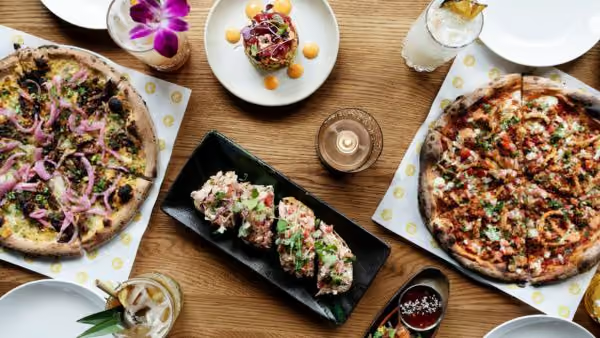
Anderson Market is not just a place to eat. At the center of the space sits The Pantry, a curated retail experience that blurs the line between grocery shopping and discovery. Guests browse butcher cuts, fresh seafood, baked goods, prepared foods, and pantry staples meant to be taken home, not rushed through. The market functions as a neighborhood grocery stop without feeling transactional, offering items selected with intention rather than volume.
Beyond daily shopping and dining, Anderson Market also operates as a catering and events destination. Seasonal and holiday menus allow guests to extend the experience beyond the building, whether they are hosting a gathering, planning a celebration, or feeding a crowd. Catering has become a natural extension of the market’s role as a neighborhood resource, designed to meet guests wherever they are.
The vendor mix reflects that same philosophy. In addition to Booskerdoo, Anderson Market is home to The Butcher & the Bull, Fleur de Mer, Local 130 Seafood, Nick & Sons Bakery, Nonamē Noodles, Molly Boards, Namkeen, and a rotating selection of prepared foods, salads, and specialty offerings. Each vendor maintains its own identity, while operating within a shared ecosystem.
That cohesion, however, depends heavily on what happens behind the scenes.
How GoTab Addressed Anderson Market's Challenges
Operating a market that combines dining, grocery shopping, and digital ordering requires more than a traditional point-of-sale system.
Guests shop across stalls, buying seafood by weight, picking up pantry items, adding prepared foods, and expecting to check out once. Vendors need accurate sales attribution, even when a product is scanned at a register that does not belong to them. Upstairs office tenants want food delivered efficiently and the vendors want to serve them without incurring third-party fees. Guests want the freedom to choose how they order.
GoTab provided the flexibility Anderson Market needs to support that complexity without fragmenting the experience.
One of the most critical solutions is in-counter scanning paired with price-embedded bar codes. Grocery-style and weighed items are labeled with bar codes that include pricing information and vendor attribution. When scanned, GoTab recognizes both the price and the originating vendor.
“When that barcode gets scanned in GoTab, the seafood vendor gets the sales, even if the guest is checking out with other products,” Viola said. “We’ve been able to customize the sales channels.”
The system allows guests to move freely throughout the market without worrying about where to pay, while ensuring vendors are compensated. It also enables guests to purchase items even when a stall is not staffed, maximizing inventory movement and revenue.
GoTab also supports QR ordering throughout the building, including offices and service spaces above the market, routing orders accurately and allowing Anderson Market to keep delivery in-house.
Events, Revenue & What Comes Next
Food is only part of Anderson Market's long-term vision.
From the beginning, Viola saw the space as something that should evolve throughout the day and give people reasons to return that go beyond a meal. Events have become a natural extension of that idea, turning the market into a place for gathering and shared experience.
"Within GoTab, we've been able to do direct links for people to buy tickets for events," Viola said. "Oftentimes in the past, if you have to go through a third party, the fees are astronomical. We've been able to build it out in-house."
Those events fit naturally into the atmosphere Anderson Market is creating. Viola said guests often comment less on individual vendors and more on how the space feels as a whole.
"The reaction is driven by the feeling of the space," Viola said. "There's a natural warmth when people walk in. It feels comfortable. It feels like a place they want to spend time."
That sense of comfort is what allows events to work, and what gives the market room to grow beyond daytime traffic.
Future plans include a cocktail bar, expanded outdoor seating, and additional private event capabilities. Each phase builds on the same foundation: a flexible concept supported by technology that can scale without losing the warmth that makes people want to come back.
Anderson Market aims for each vendor to have their own brand and personality, “but I want the guest to feel like it’s one cohesive collective,” he added. "We really needed the technology to do a lot of the lifting for that."
Only a few months after opening, Anderson Market is still coming into its own. But the foundation is already clear. Seven vendors operating together, one shared guest experience, and a community that has embraced the vision. Powered by GoTab.
Key Takeaways
Venue: Anderson Market; Red Bank, New Jersey
Opened: Sept. 9, 2025
Founder: Chris Viola, founder of Culture Collective
Concept: Hybrid food hall, grocery, catering hub, and community-centered third place
Implementation Timeline:
Approximately 18 months from concept to opening
GoTab Tools Used:
- GoTab POS and online ordering
- In-counter scanning & price-embedded bar codes for grocery and weighed items
- Multi-vendor sales attribution
- QR ordering for in-building and office delivery and no third-party ordering fees
- Ticketed events with direct purchase links and no integrations or third-party fees
- Kitchen display systems and handheld devices
Why It Works: GoTab allows seven independent vendors to operate as a collective, handling grocery scanning, multi-vendor checkout, and flexible ordering without exposing complexity to guests. The result is a market that feels warm, navigable, and built for how people actually move through a space.
Interested in building a hospitality experience like this? Now is the time. Learn how GoTab supports multi-vendor, multi-experience concepts at GoTab.com. Request a demo or contact our team to see how GoTab can support your vision.
For the technology and guest-experience principles behind stories like this, see The Modern Food Hall Technology Guide or start with What Is a Food Hall? The Complete Guide to Modern Food Halls.