




By layering mobile ordering onto its RFID model, The Golden Mill gave guests more ways to order without changing what makes the venue successful.
On a busy Saturday at The Golden Mill, even co-owner Corby Felsher could not get through the food lines.
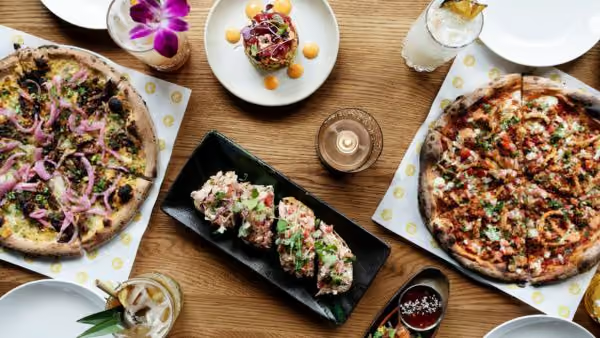
When Felsher worked the floor as a porter, he refused to cut in front of guests waiting for tacos, barbecue, burgers or sushi. Instead, he left his own building, walked down the street and bought food from the gas station.
“I’m not going to cut in line,” Felsher said. “I’m not going to say, ‘Hey, who am I to skip ahead?’ So I would go down and get a hot dog.”
The story makes him laugh now, but it also reveals a real operational pain point.
If an owner has to leave the property to avoid the food line, guests are likely making the same calculation. They can grab a beer, skip the food, wait until the line clears or leave without ordering. At a venue drawing 6,000 to 7,000 visitors on a busy Saturday, every skipped food order represents more than a missed meal. It represents revenue walking out the door.
Still, The Golden Mill did not approach the pressure point as a revenue fix alone. For Felsher, the question always came back to the guest.
“Everything we do goes through the lens of guest experience, even beyond profit,” he said. “That really has to be the driver for us.”
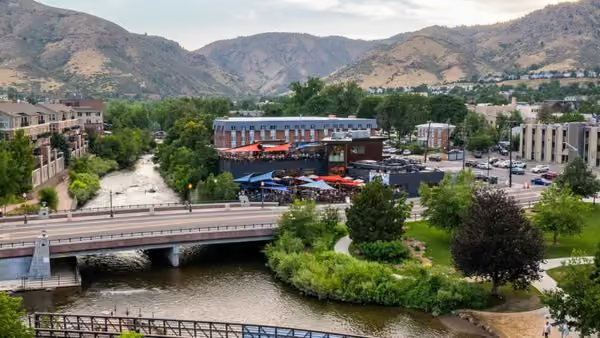
That approach matters at The Golden Mill, a 15,000-square-foot food hall and community gathering place along Clear Creek in Golden, Colorado. The venue combines mountain views, a rooftop patio, riverfront outdoor seating, five local culinary concepts, two self-pour tap walls and more than 50 taps of beer, wine, cider and house-made cocktails.
During peak periods, roughly 1,000 guests may be on site at a time. The venue is already successful. The problem was not demand. The problem was flow.
That is where GoTab’s Mobile Order & Pay enters the picture. Utilizing GoTab’s patented Easy Tab® and just a few taps on their smartphones, customers can browse through menus, place orders, and pay – all without waiting for a server. It’s fast, convenient, and enhances guest satisfaction by putting them in charge.
The result is not a replacement for The Golden Mill’s guest experience. It is a release valve for one of the busiest food halls in Colorado, giving guests more control while helping the operation capture orders that might otherwise disappear down the street.
“We are just here for guest satisfaction,” Felsher said. “Our goal is for guests who leave here to say, ‘Holy cow. That was amazing!’”
The GoTab Toolkit at The Golden Mill
The Golden Mill did not bolt on a single tool and expect it to fix a complex flow problem. It uses GoTab to support an operating model that already works.
RFID cards: Every guest checks in with a host, links a payment card and receives an RFID card that works across the tap walls and vendor counters.
Self-pour tap wall: Guests use their RFID cards to serve themselves across more than 50 taps, reducing dependence on traditional bar service.
Mobile Order & Pay: Guests who activate the Easy Tab text-based tab link can order food from their phones instead of standing in a vendor line.
Easy Tab: Guests can view their running tab in real time, track spending and see their charges in real time.
Remote tab closeout: Guests can close their tab from their phone or drop their RFID card on the way out and let staff close it automatically.
Together, those tools give guests more control while helping staff manage volume across a large, fast-moving property.
Why the Golden Mill Released Mobile Ordering with a Layered Approach
Corby Felsher and his team had discussed mobile ordering for nearly two years before fully committing to it. Early visits to other venues showed them that the technology worked best when it was built intentionally into the service model, rather than simply added on top of existing operations.
The Golden Mill had no interest in adding technology just to add technology.
“It’s already working, and we have enough business,” Felsher said, describing his early hesitation. “If people are in line for 10 minutes to get their food, it’s fine.”
The shift came when GoTab’s Morgan O'Sullivan, their dedicated account manager, started to consult with their team. A former food hall owner-operator, Morgan understood their operating model and helped The Golden Mill think through mobile ordering in a way that fit their guest experience.
“He is a godsend,” Felsher said. “He focused on us and this idea. Without him, I don’t know if we would have gotten here.”
Instead of replacing The Golden Mill’s RFID system, GoTab’s mobile ordering was added as a new option for guests.
Every guest still starts at the host stand. Staff still explain the venue, link an RFID card to the guest’s payment card and preserve the personal welcome that helps first-time visitors understand how The Golden Mill works. The only major change is that guests can now activate a text-based tab link during check-in.
That link gives them access to mobile ordering, real-time tab tracking and remote closeout.
Guests who want to order from their phones can do so. Guests who prefer to walk up to a vendor counter can still use the RFID card. Regulars get a faster path to food. First-time visitors still get the full Golden Mill hospitality experience.
The technology expanded choices without taking away the experience.
The Numbers Behind The Golden Mill’s Hybrid Service Model
Once The Golden Mill committed to GoTab mobile ordering, the results moved from theory to measurable impact.
- On an average day, mobile ordering now accounts for slightly more than 20% of orders. During the venue’s busiest periods, that number climbs above 30%.
- On a Saturday with roughly 7,000 visitors, a 30% mobile ordering adoption rate means about 2,100 guest-ordering interactions move away from the physical food lines. Because many mobile orders are placed for families or small groups, Felsher estimates the actual reduction in people standing in line during peak times is closer to 40%.
“That’s well above the cut we were looking for,” he said.
The impact is not only operational. It also affects revenue behavior.
When guests are not standing in a food line, they are free to stay in the experience. They can pour another beer, order another cocktail, sit with their group or keep enjoying the venue instead of waiting in a queue.
On a strong Saturday, The Golden Mill can generate about $100,000 in sales. In that environment, even a modest improvement in food accessibility creates meaningful upside. Guests who might have skipped food now have a lower-friction way to order. Vendors see more food sales. The venue keeps guests engaged longer.
“Now we’re selling more food,” Felsher said. “All the vendors are noticing more food sales based on our numbers and the guest experience.”
The numbers also helped validate the rollout internally. The team did not have to guess whether mobile ordering was working. They could see adoption rising, lines moving and guests using the tool during the exact pressure points it was designed to solve.
The Rollout: Slow Days First, Full Vendor Buy-in Always
The Golden Mill did not launch QR mobile ordering during a Saturday rush.
Felsher, Carli Rislov and the GoTab team started with a staggered rollout on Mondays and Tuesdays, the venue’s slowest days. Rislov serves as The Golden Mill’s Director of Training & Hospitality and operational efficiency is a key part of her role.
The team treated the first phase as a live test and invited guests into the process.
“We told guests that we are trying out this very exciting new remote ordering system,” Rislov shared. “We asked them to try it out and let us know how the experience is.”
The team studied early responses and refined the experience before expanding mobile ordering into higher-volume days.
Behind the scenes, vendor buy-in mattered just as much.
The Golden Mill team trimmed menus, simplified options and removed items that no longer made sense for a guest-facing mobile ordering experience. Vendor menus could not simply move from the counter to the phone unchanged. They had to work for guests who were ordering on their own, without a cashier standing there to explain modifiers, answer questions or walk them through too many choices.
Rislov said that shift became one of the most important parts of the rollout.
“We were about to roll out these menus to be guest-facing, not just team-facing,” Rislov said. “As you’re making those updates and making those changes, have that in mind.”
Mobile ordering forces a team to see its menu the way a guest sees it. Long menus, unclear modifiers and low-performing items create friction on a phone. The cleaner the menu, the easier it becomes for guests to order quickly and for vendors to execute during peak volume.
Felsher said the team also had to protect the rollout from doubt before it reached the guest.
“What can’t happen is the licensee going behind the scenes saying, ‘This isn’t going to work,’” he said. “You cannot say those words. We are going to make this work together.”
By the second week of testing, The Golden Mill had enough proof to move forward. The system handled real guest volume. Staff worked through the few technical issues that came up. Guests understood the option. Most importantly, mobile ordering started doing what the team needed it to do, moving guests out of physical lines without pulling them out of the Golden Mill experience.
That was when Rislov made the call. “This is permanent,” Felsher recalled her saying. “We’re not testing anymore. Let’s go.”
For Felsher, the outcome confirmed that the preparation worked. “There were very few technical errors,” he said. “The effect of it was beautiful.”
At The Golden Mill, mobile ordering did not replace hospitality. It protected it.
The venue still feels like a community gathering place. Guests still get welcomed at the door. They still pour their own drinks, meet friends, bring dogs, sit by the river and take in the mountain views.
Now, they have one more way to order food without leaving the experience.
“We’re not restaurateurs. We’re not bartenders,” Felsher said. “We’re just like Disney. We’re here to make people happy.”
KEY TAKEAWAYS
Venue: The Golden Mill, Golden, Colorado
Concept: High-volume food hall and community gathering place with local food vendors, self-pour beverage walls, rooftop patio, riverfront outdoor seating and event-driven traffic
Venue Footprint: 15,000 square feet with five local culinary concepts, two self-pour tap walls and more than 50 taps of beer, wine, cider and house-made cocktails
Peak Volume: 6,000 to 7,000 visitors on a busy Saturday, with roughly 1,000 guests on site at a time during peak periods
Leadership: Corby Felsher, co-owner and owner-operator; Carli Rislov, Director of Training & Hospitality
GoTab Account Lead: Morgan O'Sullivan
Guest Model: Host-led check-in, RFID cards, self-pour beverage service, walk-up food ordering, mobile food ordering, real-time tab tracking and remote tab closeout
GoTab Tools Used: RFID-enabled tab management, Mobile Order & Pay, Easy Tab, remote tab closeout and guest-facing digital menus
Mobile Ordering Adoption: More than 20% of orders on an average day, climbing above 30% during the venue’s busiest stretches
Line Reduction Impact: During peak periods, mobile ordering moves an estimated 30% of ordering activity out of the food lines. Because many mobile orders serve families or groups, The Golden Mill estimates the actual reduction in people standing in line is closer to 40%.
Revenue Impact: On Saturdays that can reach about $100,000 in sales, mobile ordering helps capture food orders guests may have skipped because of long lines while keeping them engaged in the venue experience.
Operational Impact: GoTab helped The Golden Mill add mobile ordering without replacing the RFID system guests and staff already trust. The rollout reduces line pressure, gives guests more control over their tabs and helps vendors serve more food during peak traffic.
Why It Works: The Golden Mill operates more like a high-volume hospitality campus than a traditional food hall. Guests move between tap walls, food vendors, patios, events, dogs, families and riverfront seating. GoTab gives the venue a flexible ordering layer that keeps guests out of lines without pulling them out of the experience.