




There’s a certain kind of chaos in hospitality that becomes so normal, people stop questioning it.
The missing cup. The inconsistent comp. The table that waits too long to be greeted. The guest who leaves thinking, eh, it was fine, when what you really wanted was we have to go back.
That’s the tricky thing about friction in hospitality. It usually doesn’t show up as one giant disaster. It shows up as a hundred tiny moments that quietly chip away at the guest experience.
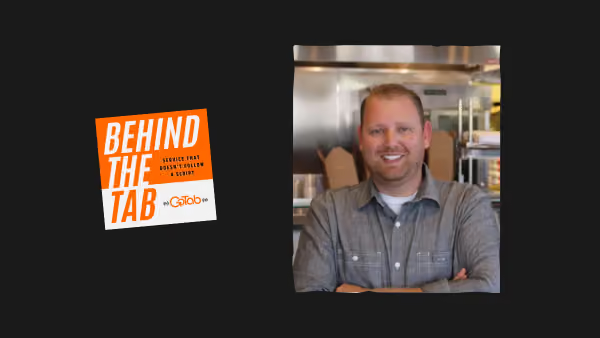
And according to Ryan Gromfin, founder of The Restaurant Boss, that friction usually doesn’t start in the dining room.It starts in the absence of systems. Ryan joined us on Behind the Tab to talk about what actually separates operators who scale well from the ones who stay stuck in a loop of putting out fires. His answer was refreshingly unsexy: Focus on building better systems and processes.
Not exactly the kind of thing that gets people fired up at a conference happy hour. But if you care about guest experience, profitability, or keeping your team sane, it matters a lot.
Everybody Wants Great Hospitality. Fewer People Operationalize It.
One of the smartest points Ryan made is that operators often confuse the thing they want with the thing they need to build.
Everyone wants great hospitality.
Everyone wants repeat guests.
Everyone wants stronger margins.
But saying “we want to create a great guest experience” is not a strategy. It’s a hope. And hope or effort won’t result in a consistently positive guest experience.
Ryan gave a perfect example: ask an owner to define customer service and you’ll usually get a beautiful answer. Something like:
- Make The Guest Feel Taken Care Of
- Make Sure They Leave Happy
- Create A Memorable Experience
All true. All important. All wildly unhelpful to the 17-year-old host working a Saturday double. Because frontline teams don’t execute aspirations. They execute instructions.
That’s where so many hospitality businesses get tripped up. Leadership has a very clear picture of what “great” should feel like, but they haven’t translated that into a repeatable way for the team to deliver it.
Or, as Ryan put it, you don’t teach “customer service.” You teach the 17 things that add up to customer service. That’s the actual work.
The Guest Feels What the Team Hasn’t Been Given
One of our favorite moments in the conversation was when we talked about friction and where it actually shows up. Because operators tend to think of guest friction as the obvious stuff:
- Long Lines
- Wrong Orders
- Slow Service
- Poor Table Turns
But a lot of the friction guests feel is much quieter than that. It’s when the team doesn’t know how to recover from something small. It’s when a service hiccup gets handled three different ways by three different employees. It’s when something feels just a little off, and the guest leaves remembering that feeling more than the food.
Patricia shared a story on the episode about a local coffee shop that ran out of the correct cup size and handed her a cappuccino in a larger cup that looked half empty. The issue wasn’t really the cup. The issue was the experience. No explanation. No confidence. No recovery. And honestly? She never went back.
That’s the danger of operational inconsistency. Guests rarely say, your SOPs need work. They just decide your place doesn’t feel polished enough to earn another visit.
The Best Operators Don’t Wing It
Ryan has a phrase for this that we love: “Jake’s Way.” Meaning, every hospitality business should know its way of doing things. Not because there’s only one correct answer. But because inconsistency is expensive. If a guest has a complaint, what happens? If the kitchen misses something, what happens? If the team runs out of cups, what happens?
There are usually several acceptable responses. The point is not choosing the perfect one. The point is choosing one, training for it, and making sure the team can execute it consistently. That’s what strong operators do differently.
They don’t assume everyone will just “figure it out.” They don’t confuse good intentions with operational clarity. And they don’t leave hospitality to chance. They define it. Train it. Reinforce it.
That’s true for service standards. It’s true for kitchen execution. And it’s very true for technology. Because if your staff is constantly compensating for broken workflows, clunky ordering, disconnected systems, or guest confusion, that operational friction eventually becomes guest friction. Every time.
Profitability Is an Output, Not a Starting Point
Ryan also said something we wish more operators heard earlier: If you do hospitality well, you get profits. If you only focus on profits, you often lose both.
That doesn’t mean margins don’t matter. They absolutely do. But in hospitality, profitability is usually the result of doing a lot of other things well first. Things like:
- Hiring And Training Well
- Building Repeatable Service Systems
- Creating Less Friction For Guests And Staff
- Giving Managers Better Tools
- Making It Easier For Guests To Order, Pay, And Come Back
This is especially important right now because hospitality has gotten a lot more operationally complex. Guests don’t all want to order the same way anymore.
Some want to order at the bar.
Some want to scan and reorder from their seat.
Some want to open a tab and keep moving.
Some want speed.
Some want service.
Most want both.
And when your systems can’t support that flexibility, your team ends up bridging the gap manually. That’s not sustainable. And it’s definitely not scalable.
Great Hospitality Should Feel Easy. But It Is Built Very Intentionally.
The best guest experiences feel effortless.
Easy to order.
Easy to pay.
Easy to get what you need.
Easy to want to come back.
But as anyone in this industry knows, “easy” is usually the result of a lot of hard thinking behind the scenes. That’s what Ryan’s perspective gets exactly right. Great hospitality is not vague. It’s not accidental. And it’s definitely not something you can just hope your team “gets.” It’s built. One process at a time. One standard at a time. One guest moment at a time.
And the operators who win over time are usually the ones willing to do that work before the friction starts costing them guests.
If this conversation resonated, you’ll want to hear what Ryan has to say next. He’ll be delivering the closing session at next week’s sold-out Future of Food Halls conference, where he’ll go deeper on what it really takes to move from chaos to control in complex, high-volume environments.
Because in food halls especially, you don’t get the luxury of figuring it out as you go.
You need systems that scale.Teams that can execute them. And clarity on how it all fits together. We’re excited to close the day with Ryan’s perspective—and even more excited to see how operators take these ideas back into their businesses.