




Self-service technology has moved from an emerging restaurant trend to an important part of the modern hospitality experience.
Self-ordering kiosks, QR code ordering, mobile payments, self-pour beverage systems, and other forms of restaurant automation give guests more control over how they order and pay. For operators, these technologies can reduce unnecessary service steps, improve throughput, and allow staff to spend more time on the parts of hospitality that require a human touch.
But the future of hospitality is not simply “self-service.”
The bigger shift is toward hybrid service: giving guests multiple ways to interact with a venue while connecting those experiences through a single restaurant technology platform.
A guest might order from a bartender, add another round from a phone, purchase food at a self-ordering kiosk, and close the tab digitally. The technology should make those interactions feel like one experience rather than separate transactions.
That flexibility is increasingly important for restaurants, breweries, food halls, hotels, resorts, and entertainment venues where one service model may not work for every guest—or every moment.
What Is Restaurant Self-Service Technology?
Restaurant self-service technology allows guests to complete parts of the ordering or payment process without requiring a staff member to handle every step.
Common examples include:
- Self-ordering kiosks
- QR code ordering
- Mobile order and pay
- Contactless payments
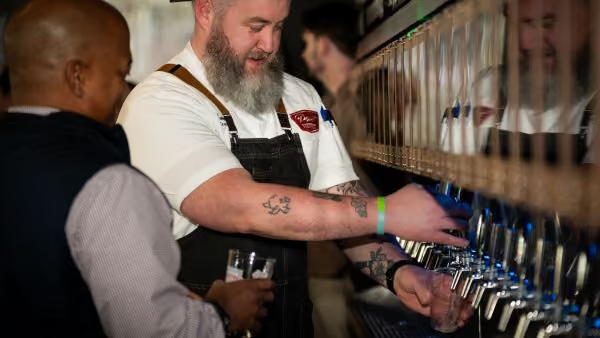
- Self-pour beer and beverage systems
- Digital check access and payment
- Online ordering
- RFID-enabled ordering and payment
The goal is not necessarily to remove employees from the guest experience. The most effective self-service models automate repetitive transactions so employees can focus on service, problem-solving, recommendations, and hospitality.
Why Are Restaurants Adopting More Self-Service Technology?
Traditional restaurant service often requires employees to act as intermediaries between guests and the systems running the business.
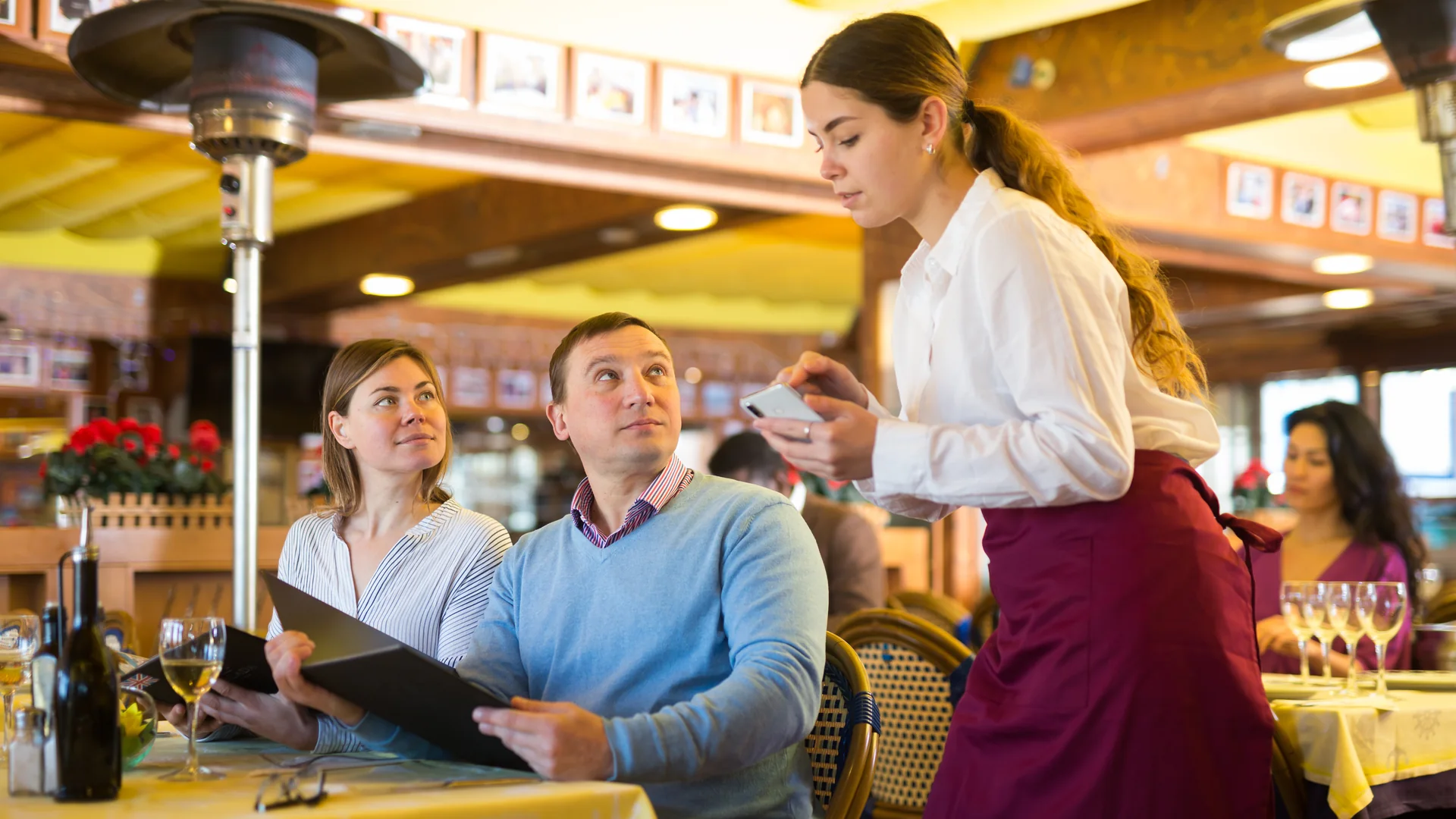
Consider something as simple as ordering another drink. A guest may need to get a server’s attention, place the order, wait for it to be entered into the POS, wait for the drink to be prepared, and then wait again for it to be delivered.
Technology can eliminate some of those unnecessary steps.
With mobile ordering, for example, a guest can place another order when they are ready. With a self-ordering kiosk, guests can browse a menu, customize their selections, order, and pay without waiting in a cashier line. With self-pour technology, guests can access beverages directly.
The result is not just automation. It is a different allocation of time.
Guests spend less time waiting. Employees spend less time entering orders and processing routine transactions. Operators can focus labor on the moments where employees create the most value.
Self-Ordering Kiosks Help Restaurants Serve More Guests
Self-ordering kiosks have become one of the most visible forms of restaurant self-service technology.
A restaurant kiosk allows guests to independently browse the menu, customize items, submit an order, and pay through a digital interface. In high-volume environments, kiosks can help reduce pressure on traditional ordering lines and create additional points where guests can place orders.
They can be particularly useful in:
- Quick-service and fast-casual restaurants
- Food halls and multi-vendor venues
- Stadiums and entertainment venues
- Breweries and taprooms
- Coffee shops
- Family entertainment centers
- Other high-volume hospitality businesses
The value of a kiosk is not simply that it replaces a cashier station. It creates another ordering option.
A guest who wants assistance can still interact with an employee. A guest who already knows what they want can order independently. During peak periods, operators can distribute demand across multiple ordering channels instead of forcing every guest into the same line.
The most effective self-ordering kiosks also connect directly with the restaurant POS, kitchen display system, menus, payments, and reporting. That prevents the kiosk from becoming another disconnected technology system for operators to manage.
QR Code Ordering Turns the Guest’s Phone Into a Self-Service Ordering Channel
Self-service does not always require dedicated hardware.
With QR code ordering and mobile order and pay, a guest's smartphone can become an ordering and payment device.
Guests can scan a QR code or access a digital ordering link to:
- View the menu
- Place an order
- Add additional items
- Pay their check
- Leave a tip
This can be especially valuable in venues where guests move throughout a large space or may want to order repeatedly during a longer visit.
Breweries, beer gardens, food halls, hotels, resorts, and entertainment venues are examples of businesses where requiring every order to pass through a traditional fixed POS terminal can create unnecessary friction.
Mobile ordering gives guests another way to access service without requiring operators to install a terminal everywhere an order might happen.
Self-Service Can Give Front-of-House Staff More Time for Hospitality
One of the biggest misconceptions about restaurant automation is that its only purpose is to reduce labor.
Technology can also change what employees spend their time doing.
When front-of-house employees are primarily responsible for taking orders, entering them into a POS, running payments, and closing checks, much of their time is consumed by transactions.
Self-service technology can shift some of those tasks to guests who prefer to handle them independently.
That gives employees more time to:
- Welcome guests
- Explain the experience
- Make recommendations
- Check on satisfaction
- Solve problems
- Build relationships
- Create memorable moments
The best front-of-house employees can do much more than take orders. Restaurant technology should give them the opportunity to do it.
Self-Service Ordering Can Reduce Lines and Improve Throughput
Long lines create friction.
They can discourage guests from placing another order, make a venue feel crowded, and force employees to spend peak periods managing queues instead of serving guests.
Self-ordering technology creates more ways for demand to enter the operation.
Instead of relying on a single ordering point, a venue might support:
- Staff-assisted POS ordering
- Handheld ordering
- Self-ordering kiosks
- QR code ordering
- Mobile payment
- Self-pour beverage service
The kitchen and bar still need the capacity to fulfill those orders, which is why self-service technology must be connected to strong back-of-house operations.
A modern kitchen display system can help route and organize orders from multiple channels so the front-of-house experience does not overwhelm production.
The objective is not simply to generate orders faster. It is to create a connected system capable of accepting, routing, preparing, and fulfilling those orders efficiently.
Self-Service Is Especially Valuable in Complex Hospitality Venues
Self-service technology becomes even more useful when the guest experience extends beyond a traditional dining room.
Consider a food hall. A guest may want to order from multiple vendors without standing in several separate lines.
At a brewery or beer garden, a guest may open a tab with a bartender and later want to order food or another round without returning to the bar.
At a hotel or resort, guests may want to order from their room, pool, patio, or another area of the property.
At an entertainment venue, guests may want to order without leaving the activity they came to enjoy.
In each case, the fundamental challenge is the same: How can guests access service when and where they want it without creating unnecessary operational complexity?
Self-service ordering is one part of the answer.
The Future Is Hybrid Ordering, Not Self-Service Alone
For most hospitality businesses, the strongest service model is not exclusively traditional or exclusively self-service.
It is hybrid.
Hybrid ordering combines staff-assisted service with digital ordering channels such as QR code ordering, mobile order and pay, self-ordering kiosks, handheld POS, and other technologies.
El cliente elige el método de pedido que mejor le funcione en el momento.
Alguien que nos visita por primera vez podría querer ayuda de un empleado. Un cliente frecuente quizás ya sepa exactamente qué quiere y prefiera pedir desde su teléfono. Una familia podría usar un quiosco porque les da más tiempo para ver el menú y personalizar su orden. Un cliente en la barra puede abrir una cuenta con el mesero y después agregar productos digitalmente.
Estas experiencias no deben funcionar como canales desconectados.
Una plataforma moderna de comercio para hospitalidad debe permitir que los pedidos, pagos, menús, datos de los clientes y flujos de trabajo de cocina funcionen en conjunto en todo el establecimiento.
Esa es la diferencia entre simplemente añadir tecnología de autoservicio y construir una experiencia realmente flexible para el cliente.
¿Qué deben buscar los restaurantes en la tecnología de autoservicio?
Los operadores que evalúen tecnología de autoservicio para restaurantes deben mirar más allá de la interfaz de pedidos.
La pregunta más importante es qué tan bien se integra la tecnología con el resto de la operación.
Las capacidades importantes incluyen:
- Integración con el punto de venta (POS): Los pedidos de autoservicio deben integrarse al mismo sistema que los pedidos ingresados por el personal.
- Integración con la cocina: Los pedidos deben enviarse automáticamente a la cocina, barra o estación de producción correspondiente.
- Múltiples opciones de pedido: Los operadores deben poder ofrecer quioscos, pedidos móviles, dispositivos portátiles y el servicio tradicional de punto de venta de forma simultánea.
- Gestión de menús en tiempo real: Los cambios en el menú, las actualizaciones de precios y los artículos agotados deben reflejarse en todos los canales de pedido.
- Pagos flexibles: Los clientes deben poder pagar utilizando los métodos adecuados para el establecimiento y el modelo de servicio.
- Datos del cliente: Las interacciones digitales deben ayudar a los operadores a comprender mejor el comportamiento de los clientes y a construir relaciones más sólidas.
- Integraciones abiertas: La plataforma debe conectarse con la otra tecnología que el negocio ya utiliza.
- Flexibilidad operativa: El sistema debe adaptarse a medida que el establecimiento, el modelo de servicio o la experiencia del cliente evolucionan.
La mejor tecnología de autoservicio debe simplificar la operación en lugar de crear otro silo tecnológico.
¿La tecnología de autoservicio reemplaza a los empleados de los restaurantes?
No necesariamente.
En muchos entornos de hospitalidad, la pregunta más útil es si la tecnología puede reducir el tiempo que los empleados dedican a tareas repetitivas.
Tomar un pedido, ingresarlo en un sistema, procesar un pago y cerrar una cuenta son funciones necesarias. Pero no siempre son los momentos en los que un empleado genera el mayor valor para un cliente.
Cuando los clientes pueden gestionar las transacciones rutinarias por sí mismos, los empleados pueden concentrarse en el trabajo que la tecnología no puede replicar: criterio, empatía, recomendaciones, resolución de problemas y una hospitalidad genuina.
Para los operadores, esto puede significar diseñar roles en torno a la experiencia del cliente en lugar de las limitaciones de un flujo de trabajo de punto de venta tradicional.
¿Es el autoservicio el futuro de los restaurantes?
El autoservicio seguirá desempeñando un papel importante en los restaurantes y la hospitalidad, pero es probable que el futuro esté definido por la elección.
No todos los clientes desean la misma experiencia. Incluso el mismo cliente puede querer diferentes niveles de servicio en distintos momentos.
La oportunidad para los operadores es crear un ecosistema tecnológico flexible donde los clientes puedan moverse entre experiencias asistidas por el personal y de autoservicio sin fricciones.
Eso podría significar pedirle a un mesero en un momento dado, usar un teléfono para la siguiente ronda, visitar un quiosco más tarde y pagar digitalmente cuando llegue el momento de irse.
Cuando esas interacciones están conectadas, el autoservicio no reemplaza a la hospitalidad.
Brinda a los operadores más formas de ofrecerlo.
Cómo GoTab apoya el autoservicio y los pedidos híbridos
GoTab ofrece a los operadores de hospitalidad la flexibilidad de combinar el servicio tradicional con tecnología de autopedido en una plataforma conectada.
Los operadores pueden gestionar pedidos mediante puntos de venta asistidos por personal, dispositivos portátiles, pedidos y pagos móviles, quioscos de autopedido y otras experiencias, conectando los pedidos con los flujos de trabajo de cocina, los pagos y los datos operativos.
En lugar de obligar a cada cliente a seguir un único modelo de servicio, GoTab ayuda a restaurantes, cervecerías, mercados gastronómicos, hoteles y centros de entretenimiento a ofrecer a sus clientes más formas de pedir, manteniendo una experiencia unificada.
El resultado es un enfoque más flexible de la hospitalidad, diseñado en torno a cómo los clientes realmente desean interactuar con un establecimiento.
¿Listo para explorar un enfoque más flexible para el autoservicio y los pedidos híbridos en restaurantes? Conozca más sobre los quioscos de autopedido y los pedidos y pagos móviles de GoTab, o solicite una demostración para ver cómo la plataforma puede apoyar su operación.