




Self-service technology has moved from an emerging restaurant trend to an important part of the modern hospitality experience.
Self-ordering kiosks, QR code ordering, mobile payments, self-pour beverage systems, and other forms of restaurant automation give guests more control over how they order and pay. For operators, these technologies can reduce unnecessary service steps, improve throughput, and allow staff to spend more time on the parts of hospitality that require a human touch.
But the future of hospitality is not simply “self-service.”
The bigger shift is toward hybrid service: giving guests multiple ways to interact with a venue while connecting those experiences through a single restaurant technology platform.
A guest might order from a bartender, add another round from a phone, purchase food at a self-ordering kiosk, and close the tab digitally. The technology should make those interactions feel like one experience rather than separate transactions.
That flexibility is increasingly important for restaurants, breweries, food halls, hotels, resorts, and entertainment venues where one service model may not work for every guest—or every moment.
What Is Restaurant Self-Service Technology?
Restaurant self-service technology allows guests to complete parts of the ordering or payment process without requiring a staff member to handle every step.
Common examples include:
- Self-ordering kiosks
- QR code ordering
- Mobile order and pay
- Contactless payments
- Self-pour beer and beverage systems
- Digital check access and payment
- Online ordering
- RFID-enabled ordering and payment
The goal is not necessarily to remove employees from the guest experience. The most effective self-service models automate repetitive transactions so employees can focus on service, problem-solving, recommendations, and hospitality.
Why Are Restaurants Adopting More Self-Service Technology?
Traditional restaurant service often requires employees to act as intermediaries between guests and the systems running the business.
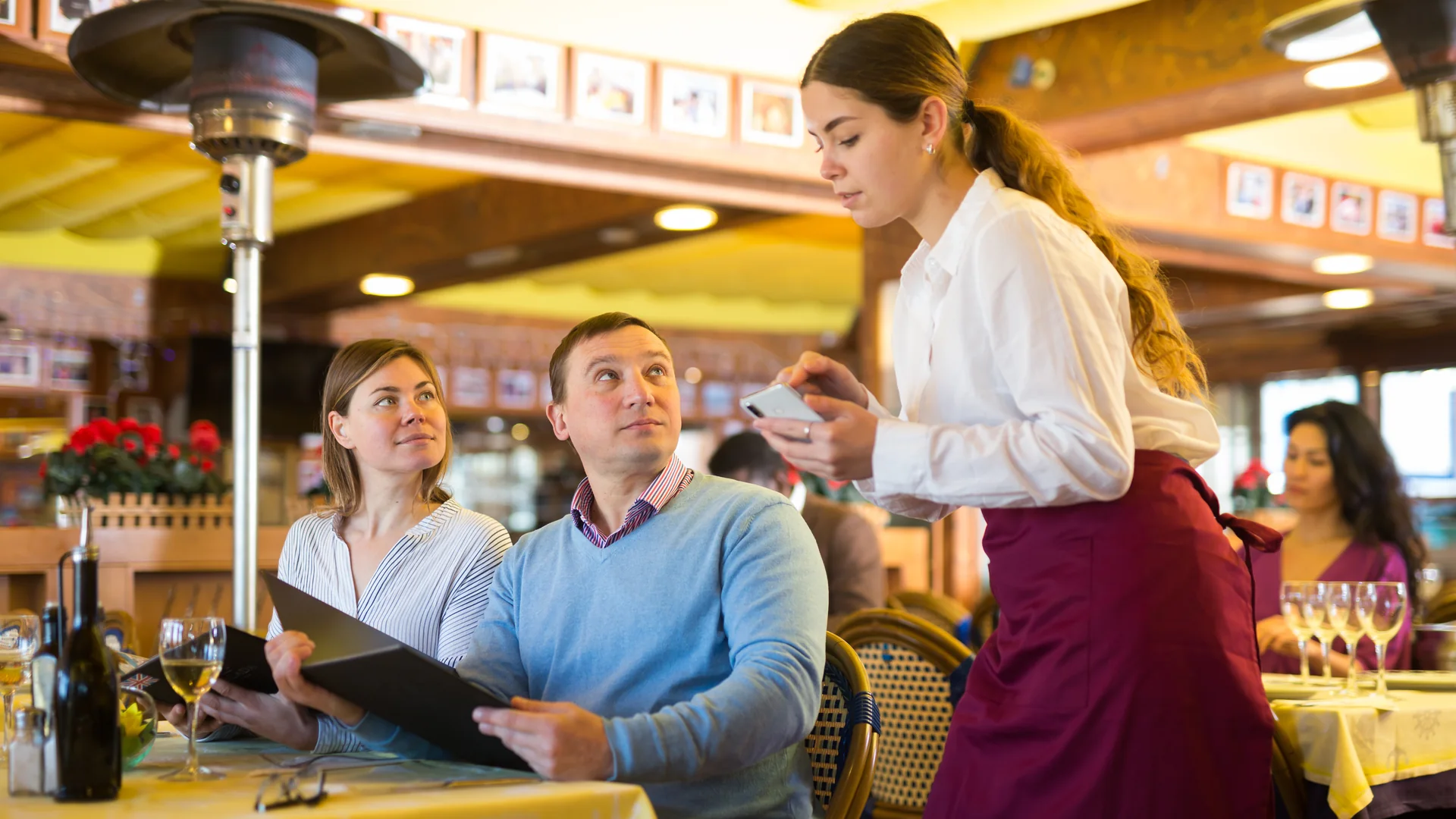
Consider something as simple as ordering another drink. A guest may need to get a server’s attention, place the order, wait for it to be entered into the POS, wait for the drink to be prepared, and then wait again for it to be delivered.
Technology can eliminate some of those unnecessary steps.
With mobile ordering, for example, a guest can place another order when they are ready. With a self-ordering kiosk, guests can browse a menu, customize their selections, order, and pay without waiting in a cashier line. With self-pour technology, guests can access beverages directly.
The result is not just automation. It is a different allocation of time.
Guests spend less time waiting. Employees spend less time entering orders and processing routine transactions. Operators can focus labor on the moments where employees create the most value.
Self-Ordering Kiosks Help Restaurants Serve More Guests
Self-ordering kiosks have become one of the most visible forms of restaurant self-service technology.
A restaurant kiosk allows guests to independently browse the menu, customize items, submit an order, and pay through a digital interface. In high-volume environments, kiosks can help reduce pressure on traditional ordering lines and create additional points where guests can place orders.
They can be particularly useful in:
- Quick-service and fast-casual restaurants
- Food halls and multi-vendor venues
- Stadiums and entertainment venues
- Breweries and taprooms
- Coffee shops
- Family entertainment centers
- Other high-volume hospitality businesses
The value of a kiosk is not simply that it replaces a cashier station. It creates another ordering option.
A guest who wants assistance can still interact with an employee. A guest who already knows what they want can order independently. During peak periods, operators can distribute demand across multiple ordering channels instead of forcing every guest into the same line.
The most effective self-ordering kiosks also connect directly with the restaurant POS, kitchen display system, menus, payments, and reporting. That prevents the kiosk from becoming another disconnected technology system for operators to manage.
QR Code Ordering Turns the Guest’s Phone Into a Self-Service Ordering Channel
Self-service does not always require dedicated hardware.
With QR code ordering and mobile order and pay, a guest's smartphone can become an ordering and payment device.
Guests can scan a QR code or access a digital ordering link to:
- View the menu
- Place an order
- Add additional items
- Pay their check
- Leave a tip
This can be especially valuable in venues where guests move throughout a large space or may want to order repeatedly during a longer visit.
Breweries, beer gardens, food halls, hotels, resorts, and entertainment venues are examples of businesses where requiring every order to pass through a traditional fixed POS terminal can create unnecessary friction.
Mobile ordering gives guests another way to access service without requiring operators to install a terminal everywhere an order might happen.
Self-Service Can Give Front-of-House Staff More Time for Hospitality
One of the biggest misconceptions about restaurant automation is that its only purpose is to reduce labor.
Technology can also change what employees spend their time doing.
When front-of-house employees are primarily responsible for taking orders, entering them into a POS, running payments, and closing checks, much of their time is consumed by transactions.
Self-service technology can shift some of those tasks to guests who prefer to handle them independently.
That gives employees more time to:
- Welcome guests
- Explain the experience
- Make recommendations
- Check on satisfaction
- Solve problems
- Build relationships
- Create memorable moments
The best front-of-house employees can do much more than take orders. Restaurant technology should give them the opportunity to do it.
Self-Service Ordering Can Reduce Lines and Improve Throughput
Long lines create friction.
They can discourage guests from placing another order, make a venue feel crowded, and force employees to spend peak periods managing queues instead of serving guests.
Self-ordering technology creates more ways for demand to enter the operation.
Instead of relying on a single ordering point, a venue might support:
- Staff-assisted POS ordering
- Handheld ordering
- Self-ordering kiosks
- QR code ordering
- Mobile payment
- Self-pour beverage service
The kitchen and bar still need the capacity to fulfill those orders, which is why self-service technology must be connected to strong back-of-house operations.
A modern kitchen display system can help route and organize orders from multiple channels so the front-of-house experience does not overwhelm production.
The objective is not simply to generate orders faster. It is to create a connected system capable of accepting, routing, preparing, and fulfilling those orders efficiently.
Self-Service Is Especially Valuable in Complex Hospitality Venues
Self-service technology becomes even more useful when the guest experience extends beyond a traditional dining room.
Consider a food hall. A guest may want to order from multiple vendors without standing in several separate lines.
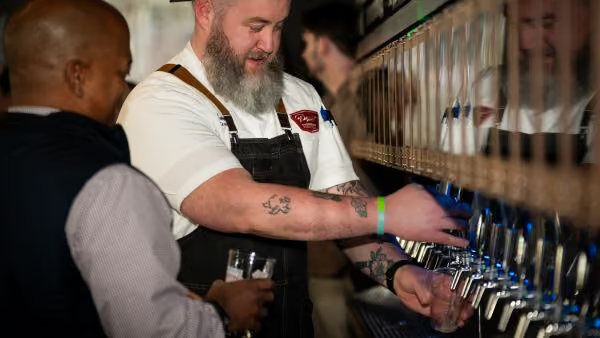
At a brewery or beer garden, a guest may open a tab with a bartender and later want to order food or another round without returning to the bar.
At a hotel or resort, guests may want to order from their room, pool, patio, or another area of the property.
At an entertainment venue, guests may want to order without leaving the activity they came to enjoy.
In each case, the fundamental challenge is the same: How can guests access service when and where they want it without creating unnecessary operational complexity?
Self-service ordering is one part of the answer.
The Future Is Hybrid Ordering, Not Self-Service Alone
For most hospitality businesses, the strongest service model is not exclusively traditional or exclusively self-service.
It is hybrid.
Hybrid ordering combines staff-assisted service with digital ordering channels such as QR code ordering, mobile order and pay, self-ordering kiosks, handheld POS, and other technologies.
The guest chooses the ordering method that makes sense in the moment.
Someone visiting for the first time may want help from an employee. A returning guest may already know exactly what they want and prefer to order from a phone. A family may use a kiosk because it gives them more time to browse and customize. A guest at the bar may start a tab with a bartender and later add to it digitally.
These experiences should not operate as disconnected channels.
A modern hospitality commerce platform should allow orders, payments, menus, guest data, and kitchen workflows to work together across the entire venue.
That is the difference between simply adding self-service technology and building a truly flexible guest experience.
What Should Restaurants Look for in Self-Service Technology?
Operators evaluating self-service restaurant technology should look beyond the ordering interface itself.
The larger question is how well the technology fits into the rest of the operation.
Important capabilities include:
- POS integration: Self-service orders should flow into the same system as staff-entered orders.
- Kitchen integration: Orders should route automatically to the correct kitchen, bar, or production station.
- Multiple ordering options: Operators should be able to support kiosks, mobile ordering, handhelds, and traditional POS service together.
- Real-time menu management: Menu changes, pricing updates, and sold-out items should update across ordering channels.
- Flexible payments: Guests should be able to pay using the methods appropriate for the venue and service model.
- Guest data: Digital interactions should help operators better understand guest behavior and build stronger relationships.
- Open integrations: The platform should connect with the other technology the business already uses.
- Operational flexibility: The system should adapt as the venue, service model, or guest experience evolves.
The best self-service technology should simplify the operation rather than create another technology silo.
Does Self-Service Technology Replace Restaurant Employees?
Not necessarily.
In many hospitality environments, the more useful question is whether technology can reduce the amount of time employees spend on repetitive tasks.
Taking an order, entering it into a system, processing a payment, and closing a check are necessary functions. But they are not always the moments where an employee creates the most value for a guest.
When guests can handle routine transactions themselves, employees can focus on the work that technology cannot replicate: judgment, empathy, recommendations, problem-solving, and genuine hospitality.
For operators, that can mean designing roles around the guest experience rather than around the limitations of a traditional POS workflow.
Is Self-Service the Future of Restaurants?
Self-service will continue to play an important role in restaurants and hospitality, but the future is likely to be defined by choice.
Guests do not all want the same experience. Even the same guest may want different levels of service at different moments.
The opportunity for operators is to create a flexible technology ecosystem where guests can move between staff-assisted and self-service experiences without friction.
That might mean ordering from a server at one moment, using a phone for the next round, visiting a kiosk later, and paying digitally when it is time to leave.
When those interactions are connected, self-service does not replace hospitality.
It gives operators more ways to deliver it.
How GoTab Supports Self-Service and Hybrid Ordering
GoTab gives hospitality operators the flexibility to combine traditional service with self-ordering technology on a connected platform.
Operators can support staff-assisted POS ordering, handhelds, Mobile Order & Pay, Self-Ordering Kiosks, and other ordering experiences while connecting orders with kitchen workflows, payments, and operational data.
Rather than forcing every guest into a single service model, GoTab helps restaurants, breweries, food halls, hotels, and entertainment venues give guests more ways to order while maintaining a unified experience.
The result is a more flexible approach to hospitality—one designed around how guests actually want to interact with a venue.
Ready to explore a more flexible approach to restaurant self-service and hybrid ordering? Learn more about GoTab’s Self-Ordering Kiosks and Mobile Order & Pay, or request a demo to see how the platform can support your operation.
Frequently Asked Questions About Hybrid Ordering
What is hybrid ordering?
Hybrid ordering is a service model that combines staff-assisted ordering with self-service technology—such as QR code ordering, mobile order and pay, self-ordering kiosks, and handheld POS—so guests can choose how they want to order at any given moment, while every interaction stays connected on the same tab and platform.
How is hybrid ordering different from self-service technology?
Self-service technology refers to the individual tools guests can use to order or pay independently, like a kiosk or a QR code. Hybrid ordering describes the broader strategy of combining those self-service tools with traditional staff-assisted service so guests can move between the two without friction.
Does adding self-service technology mean cutting staff?
Not necessarily. The goal of hybrid ordering is to shift staff time away from repetitive transactions—entering orders, running payments—so employees can spend more time on the parts of hospitality that create the most value: recommendations, problem-solving, and guest relationships.
Which venues benefit most from hybrid ordering?
Restaurants, breweries, food halls, hotels, resorts, and entertainment venues all benefit, particularly when guests are spread across a large space or want to keep ordering throughout a longer visit. See how hybrid ordering plays out specifically in food halls, where one venue saw a 46% increase in daily orders at a single vendor after adding mobile ordering alongside its existing RFID system.
Can hybrid ordering increase revenue?
Yes. When guests have more ways to order, they tend to order more often. In one food hall case, adding mobile ordering to an existing RFID-based tab system generated roughly 48 additional orders per day venue-wide, with one vendor's mobile-driven sales alone reaching $19,000 per month. Read the full food hall ordering model breakdown for the complete numbers.
How do I implement a hybrid service model at my venue?
Implementation typically starts with mapping guest expectations by daypart and service area, choosing the ordering channels (kiosk, QR, mobile, handheld) that fit each part of the venue, and training staff to introduce the new options without disrupting existing service. For a step-by-step walkthrough—including signage, wayfinding, and sample staff scripts—download the Restaurant Hybrid Service Model Implementation Guide.
Is self-service the future of restaurants?
Self-service will keep growing, but the more accurate framing is choice, not replacement. The strongest operators build a flexible technology ecosystem where guests can move between staff-assisted and self-service experiences depending on the moment, rather than betting on one model alone.