






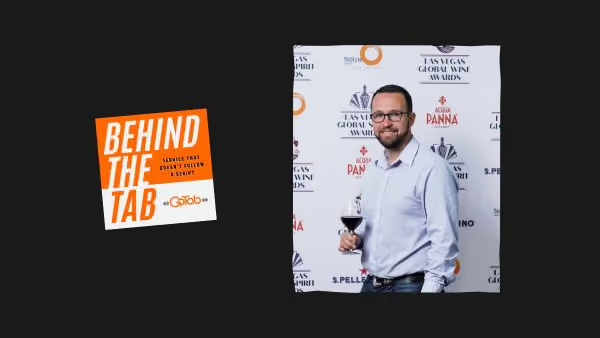
If you've ever watched a guest check their watch, scan the bar, and mouth "where's my drink?" — you already understand the problem bar automation is trying to solve. On the latest episode of Behind the Tab, GoTab's hospitality podcast, host Adam Howe sits down with Will Costello, a Master Sommelier and National Sales Director at SmartBar USA, to unpack why more operators — from Las Vegas casinos to a one-stoplight sports bar in Buckner, Missouri — are putting automated cocktail systems behind the bar.
Costello's background makes him an unusually credible narrator here. He passed one of the hospitality industry's hardest exams (the Master Sommelier exam has roughly a 3% pass rate) and spent years working service in five-star, Michelin-level rooms before moving to the technology side. That's the lens he brings to a question every operator eventually asks: does automation help or hurt the guest experience?
What Is Bar Automation, and Is It the Same as a Robot Bartender?
Bar automation refers to hardware and software that produces a consistent, pre-programmed drink recipe on demand — typically in seconds — so staff don't have to build every cocktail by hand under pressure. It is not the same as a "robot bartender." As Costello puts it on the episode, the goal isn't to remove people from the bar; it's to remove the repetition that slows people down.
"I wouldn't say they were an automated bartending company... What we are is a tool the same way that a shaker can be a tool... so that a great bartender or a novice bartender can repeat the same cocktails over and over and over again at speed." — Will Costello, SmartBar USA
That distinction matters for operators evaluating any bar POS and beverage technology: the tools worth investing in are the ones that support your staff's judgment and hospitality instincts, not the ones trying to replace them.
Does Automating Drink Production Take Away from Hospitality?
No — and this is the objection Costello hears most often, so he addresses it directly. The argument is that automation frees up staff to do the parts of hospitality that actually require a person: reading the table, remembering a regular's order, talking someone through the wine list.
"We will never be a tool that takes away from taking care of guests... we allow guests to be taken care of by the people who are best adept for that. We're creating the space for hospitality to happen." — Will Costello
Adam Howe draws the same line back to GoTab's own philosophy around QR ordering and payment: technology should absorb the repeatable, transactional work so staff aren't stuck doing it instead of hosting.
How Does a Slow Bar Actually Cost You Money?
This is the part operators should read twice. A slow or inconsistent pour isn't just a guest-experience issue — it's a forecasting and margin problem. Every drink poured by hand is subject to human variance, and that variance shows up directly on the P&L.
"If you tip the bartender a little extra you're going to get more [pour] — as an operator that should terrify you... You can't build a great restaurant's P&L without forecasting, without the ability to control the cost." — Will Costello
The revenue side of the equation is just as concrete. At high-ticket venues — concerts, stadiums, arenas — a slow drink line is effectively a tax the guest pays in missed experience:
"If it takes you 14 minutes to go get a drink and you miss three of your favorite songs, that is a tax that the guest is paying." — Will Costello
This is exactly the wait-time math behind GoTab's own stadium and entertainment venue kiosk work, where reducing concession-line congestion is treated as a fan-experience metric, not just an operations one — and it echoes what happened when Ono Brewing connected its self-pour system to a single POS: check-in and check-out time dropped by 50%, with guests moving through the line noticeably faster.
Does Bar Automation Actually Work at Scale?
Yes, and the episode's proof points span both ends of the spectrum. At Atomic Golf in Las Vegas, five SmartBar systems across four floors produce up to 2,000–3,000 drinks an hour at peak — a volume Costello says "almost no bartender could keep up with" manually. That's the same high-volume, multi-zone environment GoTab supports at venues like T-Squared Social in Manhattan, where golf simulators, bowling, and a full bar all operate under one tab that follows the guest around the building.
But the more surprising proof point is Bad to the Bone, a counter-service sports bar in Buckner, Missouri — a market you wouldn't expect to find this kind of technology. The owners told Costello they'd never run the business without it. Scale isn't the prerequisite; consistent, high-repetition drink orders are.
Is Bar Automation Right for Every Venue?
No — and Costello is refreshingly direct about where it isn't a fit. If the bartender's performance is the product — a craft cocktail bar built around theatrical, made-to-order technique — automation would undercut the exact experience guests are paying for.
"As long as you're not that Japanese-style craft cocktail bar that's lighting their bar top on fire, I think it might be worth it." — Will Costello
The venues where it fits best share a pattern: high order volume, guests who are seated away from the bar, or a business model where speed and consistency matter more than bartender showmanship — think casual dining, eatertainment venues, stadiums and arenas, casinos, and counter-service concepts of any size or market.
Where Are Guest Expectations Headed Next?
Costello's closing point is less about hardware and more about behavior: guests who grew up ordering everything from their phone are becoming the next generation of operators, and they're going to expect that same convenience at the bar. The winning move isn't forcing one style of service on every guest — it's giving people the option to order and pay how they want, then fulfilling that order fast, consistently, and well.
That's the same principle behind choosing the right bar POS system in the first place: the technology should flex to the venue, not the other way around.
Listen to the Full Episode
Costello and Howe cover a lot more than what's captured here — including a genuinely great story about a $115 bottle of wine that should have cost $20,000, and a candid conversation about why "value" means something different to every guest. Catch the full conversation on Behind the Tab, GoTab's podcast for hospitality operators, available on Spotify, Apple Podcasts, and YouTube.
Frequently Asked Questions
What is SmartBar USA?
SmartBar USA makes automated cocktail-dispensing hardware used by bars, restaurants, casinos, stadiums, and entertainment venues to produce a consistent drink recipe in seconds. It's used in the majority of casinos on the Las Vegas Strip.
Does bar automation replace bartenders?
No. Bar automation tools like SmartBar are designed to handle repeatable drink production so bartenders can focus on guest interaction, upselling, and the parts of service that require a person — not to eliminate staff.
Which venues benefit most from beverage automation?
High-volume, high-repetition environments benefit most: stadiums, arenas, casinos, eatertainment venues, casual dining, and counter-service bars. Venues where the bartender's craft performance is the guest's main draw — such as theatrical craft cocktail bars — are typically a poor fit.
How does automation affect pour cost and margin?
Automated systems pour a programmed, exact recipe every time, removing the variance that comes from manual pours (including inconsistent "extra" pours tied to tipping). That makes cost of goods sold more predictable and easier to forecast against a venue's P&L.
Can bar automation work with mobile ordering?
Yes. When paired with a mobile ordering and payment system, a guest's order can route directly from their phone to an automated dispensing system, cutting the time between placing an order and getting a drink — reducing both wait times and lost sales from abandoned orders in line.