






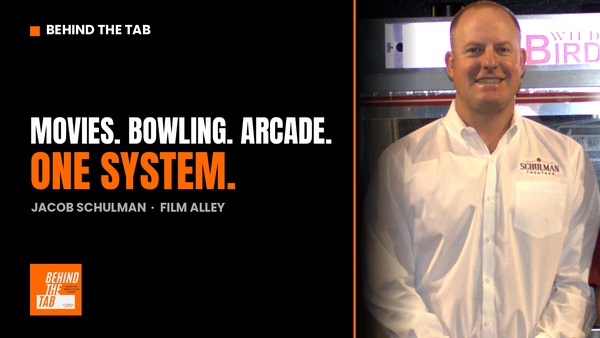
Jacob Schulman is fifth-generation ownership of a business that opened its first movie theater in 1926. A hundred years later, that same family runs Film Alley — eight movie-bowling-arcade-and-dining venues across Texas and Arkansas — and Jacob told us the honest version of what it takes to run one: "there's not really one system that does it all."
That line is worth sitting with, because it's the exact problem every family entertainment center (FEC) operator eventually runs into. You add bowling. You add arcade. You upgrade the kitchen. Each addition is a win for guests and revenue — and each one is also a new system that doesn't talk to the others. Here's how Film Alley has handled it, in Jacob's own words, and what it means for any operator trying to do the same thing at a smaller scale.
Why don't family entertainment centers use one POS system for everything?
Because no platform on the market natively covers movies, bowling, arcade, and food & beverage at once — so every multi-attraction operator ends up choosing between two imperfect options. Jacob described both:
"There's not really one system that does it all, really. And so I mean there's kind of two different mindsets: there's one where you try to go all in and find a system that can offer everything, and they're great at some and they're not so great at others — or you get good solutions for each respective one and then have integrations where you try to provide that single pane of glass. Candidly, it's been a struggle." — Jacob Schulman
Film Alley has landed on the second path — best-of-breed systems per attraction, tied together into one operational view — and Jacob credits GoTab specifically with making that workable: "I think GoTab has been a very huge plus for us because it's helped us kind of move in that direction. Between our ticketing and our bowling and our arcade, it's been a struggle from a management standpoint to provide the operational consistency that we need but also really have the optimal guest experience." That's the design philosophy behind GoTab's family entertainment center POS: RFID and cashless integrations with partners like Intercard and Amusement Connect tie arcade, food, and beverage onto a single guest tab, without requiring a venue to rip out its existing bowling or arcade card system. The same open-API approach carries through GoTab's broader eatertainment platform, which is built to sit on top of whatever ticketing or reservation systems a venue already runs and unify ordering, payment, and reporting across them.
How did a 100-year-old movie theater chain become a multi-attraction operator?
By testing the model on someone else's business first, then building its own version once it worked. Schulman Theatres didn't start as a bowling-and-arcade company — it spent most of a century running traditional single-screen and drive-in movie theaters before adding anything else.
The shift started small: in 2006-07, the company was asked to manage a struggling dine-in theater and used it to test food and beverage service in a cinema setting. Then in 2012, Film Alley's first real location came together almost by accident — a failed bowling-arcade-movie property in Bastrop, Texas, went up for auction, and Schulman bought and expanded it. That success is what convinced the family to design a location from scratch around the combined concept, which became the template for Film Alley Weatherford and Terrell. GoTab's own case study on the company covers what happened next in more detail — one Film Alley location saw sales triple to quadruple within a month of switching ordering systems, even with attendance down from prior levels.
Today, that model runs across eight locations: two near Austin, two in the Dallas-Fort Worth market, three in East Texas, and the company's first out-of-state location in Little Rock, Arkansas.
Does adding bowling and arcade actually keep guests at a venue longer?
Yes — and Film Alley tracks it deliberately rather than assuming it. Jacob's team measures dwell time and cross-attraction movement (guests who bowl and also see a movie, or hit the arcade between the two) because the whole point of the combined format is getting one visit to cover more ground than "just the movie."
"Once they're there, that's one of the hardest things in any business, right, is to get them in the door. And then once they're there, we want to sell them as much as we can and offer as much as we can so that they hang out — and also create the spaces where they're comfortable hanging out as well." — Jacob Schulman
That shows up in physical design choices as much as technology ones: bowling-side seating for parents, spillover tables near the arcade so a guest can watch their kids play without losing their spot. It's the same logic behind GoTab's guidance for bowling alley operators specifically — one bowling venue that unified lane-side ordering with its self-pour beverage system saw an 18.6% lift in weekend food and beverage sales once ordering friction dropped, simply because guests who were already staying longer found it easier to keep spending.
Should guest experience or operational efficiency drive technology decisions?
Guest experience, every time, according to Jacob — even when the more "efficient" option would make life easier for his own team.
"If the guest doesn't like it, then I mean they're going to choose somewhere else, regardless how much easier it is for us to count and reconcile money. That's been our focus — trying to marry both worlds with the guest focus and the guest journey as the primary focus." — Jacob Schulman
In practice, that means Film Alley didn't force every guest into one ordering mode. QR ordering handles the guest who doesn't want to flag anyone down; a live server is still one tap away for the guest who does. It's the same reasoning behind treating food and beverage quality as non-negotiable rather than an afterthought to the movie or the lanes — Jacob is candid that Film Alley is competing directly with sit-down restaurants for the same night-out spend, so "we have to compete with them on a quality level."
Why are family entertainment centers expanding into smaller markets instead of big cities?
Because a multi-attraction venue can be the entertainment destination for an entire region if it isn't competing against ten other options within the same 30 minutes. Film Alley avoids Texas's largest metro markets — Dallas, Fort Worth, Houston — on purpose.
"It is by design for sure. We target secondary or tertiary markets... what we try to do is we try to find regional hubs, if you will — ones that draw from that your guests are already used to driving a decent distance to get to you. You really are that entertainment destination." — Jacob Schulman
For an operator running a single location, the same principle scales down: the venue doesn't need to be everything to a metro area, it needs to be the obvious choice for its actual draw radius — which is exactly why a multi-location or enterprise-level operator still needs one consistent operational view across sites even when each site's market looks different.
What's next for family entertainment center technology?
More flexibility, not more automation for its own sake. Jacob expects ordering to keep splitting between fully hands-off (QR, kiosk, mobile) and human-assisted, with guests choosing per visit rather than being forced into one mode — and he expects food and beverage quality expectations to keep climbing as FECs compete more directly with restaurants for the same spend. On the attractions side, Film Alley recently installed a direct-view LED screen (built like an actual perforated movie screen, so cinema-quality audio survives the format change) and continues expanding lane variety, including duckpin bowling at three of its eight locations, to keep the format itself feeling current.
None of that changes the underlying operational bet: more attractions under one roof means more systems to reconcile, not fewer — which is exactly why "single pane of glass" is the phrase Jacob keeps coming back to.
Listen to the Full Episode
Adam Howe's full conversation with Jacob Schulman covers more than what's captured here — including the family's plans for handing the business to a sixth generation of Schulmans and why "we're never getting pre-COVID construction costs again" gets a laugh and a groan in the same breath. Catch it on Behind the Tab, GoTab's podcast for hospitality operators, available on Spotify, Apple Podcasts, and YouTube once the episode is live.
Frequently Asked Questions
What is Film Alley?
Film Alley is the family entertainment center brand built by Schulman Theatres, combining movies, bowling, arcade, and a full-service kitchen. It's the company's primary growth concept, alongside its traditional City Lights movie theaters.
Does GoTab replace a family entertainment center's existing bowling or ticketing software?
No. GoTab is built with an open API specifically to integrate with the systems a venue already runs — bowling software, arcade card systems, ticketing platforms like Ready Theatre Systems — rather than requiring an operator to replace them, unifying ordering, payment, and reporting across all of them instead.
How many Film Alley locations are there?
Eight, spanning the Austin, Dallas-Fort Worth, and East Texas markets, plus the company's first out-of-state location in Little Rock, Arkansas.
Is a unified ordering and reporting system only useful for large, multi-location chains?
No. Any single venue combining food service with a second attraction — bowling, arcade, movies, or otherwise — runs into the same fragmentation problem Jacob describes; the fix scales down to one location just as it scales up to eight.