






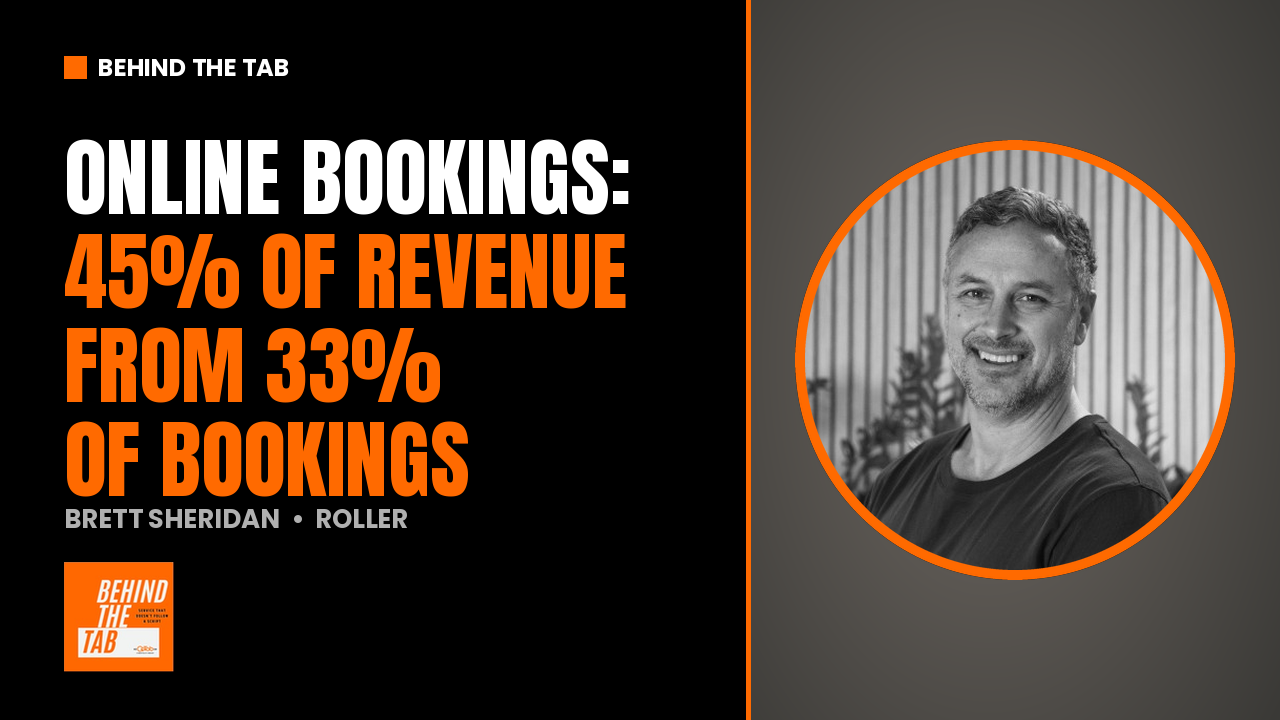
Online bookings bring in 45% of attraction revenue from just 33% of bookings. ROLLER's Brett Sheridan explains what operators can do with that, and how food and beverage fits in.
Listen on Spotify or watch on YouTube.
Brett Sheridan is General Manager at ROLLER, the software platform for attractions. Before that he spent his career as an operator: he has run iFLY indoor skydiving in Asia-Pacific and Luna Park Sydney, and he spent years building businesses where the experience is the main event. At ROLLER he represents operators inside the product, so the platform builds what actually helps their businesses.
He joined our host, Patricia Mejia, on Behind the Tab just ahead of IAAPA Expo to talk about what attractions and family entertainment centers (FECs) can learn from the data and from his years on the floor. Here is what he says operators should know.
Why Do Online Bookings Bring In More Revenue at Attractions?
Because online guests spend more per booking. According to ROLLER's 2026 Attractions Industry Benchmark Report, online checkouts make up 33% of bookings and 45% of revenue.
Brett points to two reasons. First, groups and parties used to book by phone, and that has shifted. He says 71% of birthday parties and small groups now book online. Second, add-ons attach more easily in a checkout flow than at the counter.
"That flow is a lot easier than... training a point of sale staff person to sell that add on or the right add on at the right time." — Brett Sheridan
ROLLER also reports that mobile food and beverage order values are 3.3x higher than point-of-sale purchases.
So how do you get guests to book online? Brett's examples are practical. Discount online, and have your call center script say so. Build a faster way in on site. At Luna Park, which drew about 6,000 people a day, his team created an online-only queue where guests tap in with a card or ticket. That also meant fewer staff at the gate.
"You can book online and you get 5% off your packages. Those sorts of elements, those small things matter." — Brett Sheridan
Should Every Attraction Push Online Booking?
No. Brett says it depends on the type of attraction and the guest. Some operators worry they will lose the customer if they push online, and sometimes they are right.
"If I'm going to a trampoline park, for example, and I go there four times every month, I may not just purchase online. I might just come up and I want to talk to someone." — Brett Sheridan
For amusement parks and larger attractions, where busy days can mean missed sales, guests are more likely to buy ahead. Brett says ROLLER's benchmark report breaks results out by vertical so operators can compare themselves with their own segment.
Why Is Food and Beverage Not an Afterthought at Attractions?
Because treating it as one costs you spend. Brett learned that at iFLY, where the team built heavy, capital-intensive centers around the flying and added a cafe at the end of the build.
Cafe margins are thin without volume, he says, and that afterthought hurt. After the first venue they changed course and built food and beverage into the whole guest journey: into the packages, into the experience before guests arrive, as an add-on at checkout, and with ordering from wherever guests are on site.
"Don't treat those things as an afterthought. Build it into the experience, and that'll increase your spend per guest." — Brett Sheridan
This is the problem QR code ordering is built for: guests order and pay from their phone, and the tab follows them around the venue. For more on what FECs need, see our post on what's powering the new guest experience at FECs and bowling centers.
Alcohol is a venue-by-venue call. iFLY has none on site, since a drunken flyer and hard glass do not mix, Brett jokes. But the last two centers were built near social areas, so guests could go for a drink afterward.
How Can Attractions Raise Spend per Guest?
By looking at the parts of the visit you have stopped paying attention to. Brett calls spend per guest the metric that matters most, and tracks it per visit and over a guest's lifetime.
His example is the midway at Luna Park Sydney. The team treated the sideshow games as a small distraction, and the walk through felt like a gauntlet. They realized the spend there was weak, and that lifting it would change the mix across the park. So they brought in a specialist partner, redid the midway, and promoted it before guests arrived.
"If we increase the spend there, just by a dollar or so, it completely changes the spend per guest mix across the park." — Brett Sheridan
The spectators matter too. Parents and friends who come to watch are easy to forget when you design around the people taking part.
"You've got to consider all elements, not just the people taking part or the people on the rides." — Brett Sheridan
Why Do Birthday Parties Matter Beyond the Day's Revenue?
Because every party brings in new guests. Brett calls parties an arrowhead product: the parent buys the party, and a dozen or so other guests who may never have visited come in with their families.
"You're bringing in 12 people that have never been here before, and they have parents and they have siblings and they have friends that they can also bring back." — Brett Sheridan
ROLLER's report backs up the repeat-visit effect. It found that guests at venues offering parties return 41% of the time, compared with 26% at venues that do not. Brett says the average party in the report is around 13 guests.
His advice is to build value in rather than discount. Add a host, cake, a private room, and perhaps a champagne upsell for the parents, and make sure guests leave with a reason to return, such as a discount or a membership. An online RSVP and waiver also captures the parents' details for follow-up.
Why Can a Drop in Spend per Guest Hide a Bigger Story?
Because the average hides who is visiting. Brett's own example: spend per guest dropped by a couple of dollars, and the cause was not the food or the rides.
"I realized that we had 700 kids in the park over the last week." — Brett Sheridan
School groups can spend little or nothing, while tourists spend the day and eat lunch on site, and local visitors often bring their own food. His advice is to break spend per guest out by department, such as food and beverage or retail, and by guest segment. Then you can see which segments spend, target them in your marketing, and plan around the days big groups come in.
How Does the GoTab and ROLLER Integration Help?
It puts food and beverage on the same booking and the same guest record as the ticket. In GoTab's announcement of the ROLLER integration (more on the GoTab and ROLLER integration page), ROLLER keeps online bookings, capacity, check-in, waivers, and deposits, while GoTab handles food and beverage ordering and payment.
Staff can pull a ROLLER booking onto a GoTab tab in one tap. Booked items, prices, and discounts come across, and payments already made in ROLLER are applied. When the tab closes, payments, tips, and items added in GoTab are written back to the ROLLER booking.
Brett describes what that means for operators:
"It allows the record of spend to come back into the guest record." — Brett Sheridan
With ticket spend and food and beverage spend side by side, operators can see which guests come back and spend, and which come back and do not. It is also the data you need for the segment view above.
GoTab will demo the integration at ROLLER's booth (W2201) at IAAPA Expo in Orlando, November 17 to 20, 2026, according to the announcement. Meet GoTab at IAAPA Expo 2026 to see it in person.
What Is Next for Attractions and Food and Beverage?
More venues are mixing eating with play, and Brett sees that growing. He says social competitive venues are booming in Europe and are now arriving in Australia and New Zealand, while restaurants, hotels, and cinemas are adding attractions to their existing sites.
"I think it all bodes well for the mix of eating and attractions." — Brett Sheridan
That is the direction of venues we work with every day. If you run a bowling center, arcade, or FEC, see our eatertainment POS page and our post on how GoTab powers modern cinema and family entertainment. Our Manager Dashboard shows sales and product mix in real time, which is where a spend-per-guest review starts.
One Question for Operators
Brett's advice comes back to the same thing: know where your guests' spend really comes from. If someone asked you today how much of your revenue comes from online bookings, parties, and food and beverage, could you answer, and by guest segment?
FAQ
What share of attraction revenue comes from online bookings?
According to ROLLER's 2026 Attractions Industry Benchmark Report, online checkouts account for 45% of total revenue from 33% of total bookings.
How can attractions get more guests to book online?
Brett Sheridan suggests a discount for booking online, a call-center script that mentions it, and a faster way in on site, such as an online-only queue with tap-in. He also notes the right approach varies by type of attraction and guest.
Why should food and beverage be part of the booking?
Brett says treating it as an afterthought hurt spend at iFLY. Building it into packages, checkout add-ons, and on-site ordering increases spend per guest. ROLLER reports mobile food and beverage order values are 3.3x higher than point-of-sale purchases.
Does GoTab integrate with ROLLER?
Yes. GoTab announced a ROLLER integration on October 22, 2026. ROLLER manages bookings, deposits, and waivers, while GoTab handles food and beverage ordering and payment, with payments, tips, and items written back to the ROLLER booking.
Are birthday parties worth offering at a family entertainment center?
ROLLER's report found guests at venues that offer parties return 41% of the time, compared with 26% at venues that do not. Brett says parties also bring in new guests, and an online RSVP captures their details.
What is spend per guest, and why can it mislead?
Spend per guest is how much an operator makes from each guest over a visit and over time. Brett says it can hide segment effects, such as a week with a large school group, so operators should review it by department and segment.
Listen to the full conversation on Spotify and YouTube. Connect with Brett Sheridan on LinkedIn. Download ROLLER's 2026 Attractions Industry Benchmark Report.