




Crowded Taprooms Don’t Automatically Mean Profitable Operations
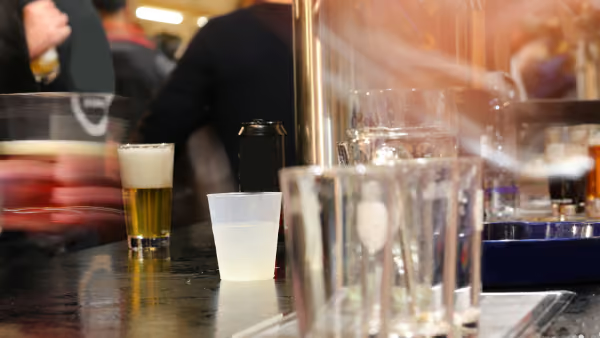
A packed brewery used to be the goal. Full tables. Long lines. A crowded bar three people deep. But in today’s craft beer market, busy doesn’t always mean profitable.
Many breweries are discovering that high traffic alone doesn’t guarantee stronger margins, happier guests, or sustainable operations. In fact, some of the busiest taprooms quietly lose revenue every night through service bottlenecks, abandoned tabs, long wait times, inefficient labor allocation, and missed ordering opportunities. As craft beer growth flattens across much of the industry, the operators continuing to grow are thinking differently. They’re not just trying to get more people through the door. They’re designing operations that capture more revenue from every guest already inside.
That shift is changing how breweries think about service.
The Real Cost of Friction in Guest Ordering
Most operational problems in breweries aren’t immediately obvious:
- A guest waits a little too long to order another round.
- A line always forms at the bar during a rush.
- Servers spend most of their shift walking back and forth instead of selling.
- The kitchen gets overwhelmed because orders arrive all at once without intelligent routing.
- Guests skip food because ordering feels complicated.
Individually, these moments seem small. Collectively, they become expensive. The hidden cost of busy is friction. Friction lowers throughput, reduces average check size, increases labor pressure, and limits how much revenue a brewery can actually capture during peak volume. And many traditional POS systems were never designed for the dynamic, multi-zone reality of modern breweries.
Today’s brewery environments are more complex than ever:
- Indoor and outdoor service areas
- Beer gardens and rooftops
- Food trucks and rotating vendors
- Self-pour walls
- Events and live music
- QR ordering and counter ordering happening simultaneously
- Guests moving freely throughout the venue
Trying to force those environments into rigid service models creates operational drag. The breweries performing best right now are removing that drag.
Throughput Is the New Growth Strategy
When traffic slows industry-wide, maximizing throughput becomes one of the fastest ways to improve profitability.
That doesn’t mean rushing guests out.
It means:
- Reducing unnecessary wait times
- Making ordering easier
- Increasing ordering frequency
- Helping staff focus on hospitality instead of transactional bottlenecks
- Capturing more orders during peak demand
The result is often higher revenue without adding more staff. High-performing breweries are increasingly adopting flexible service models that allow guests to order from wherever they are, whenever they want, while still maintaining a strong hospitality experience. That’s where modern brewery operations are headed.
How Breweries Are Reducing Friction with GoTab
GoTab was built around the idea that hospitality venues should adapt service to the guest experience — not force guests into rigid operational limitations. For breweries and taprooms, that means creating flexible service flows that increase speed, throughput, and guest spend without sacrificing hospitality.
Easy Tab® and Shared Tabs Increase Additional Rounds
One of the biggest revenue killers in busy breweries is the difficulty of reopening tabs or ordering additional rounds. GoTab’s Easy Tab allows guests to start and share tabs digitally, making it easier for groups to continue ordering throughout their visit without waiting at the bar repeatedly. That reduced friction often translates directly into higher guest spend and longer dwell times.
Mobile and QR Ordering Reduce Lines and Labor Pressure
Long lines don’t just frustrate guests. They limit revenue capacity. Mobile ordering and QR ordering allow large breweries, taprooms and beer gardens to distribute ordering volume across the entire venue instead of concentrating demand at a single POS terminal or bar station. This helps:
- Reduce crowding
- Increase ordering frequency
- Improve speed during peak rushes
- Allow smaller teams to handle larger volumes efficiently
For many breweries, this creates a better guest experience while simultaneously lowering labor strain.
Kitchen Display Systems (KDS) Improve Throughput
Food service complexity has increased significantly inside breweries. Many taprooms now operate full kitchens, partner with food trucks, or support multiple preparation zones simultaneously. GoTab’s Kitchen Display System helps breweries:
- Route orders intelligently
- Manage production timing
- Reduce bottlenecks
- Improve visibility across stations
- Support hybrid ordering environments
Instead of kitchen chaos during peak periods, operators gain operational flow.
Zone Overrides and Dynamic Service Routing
Modern breweries are rarely static environments. Service changes throughout the day depending on weather, events, staffing levels, crowd density, and venue activity. GoTab allows operators to dynamically adjust service zones and routing so the operation can adapt in real time instead of relying on fixed workflows. That flexibility becomes critical during high-volume weekends, live events, and seasonal traffic spikes.
Self-Ordering Kiosks Capture Revenue Faster
Some guests want interaction. Others simply want speed. Self-ordering kiosks give breweries another way to reduce lines and increase throughput during high-volume periods without increasing staffing requirements. Kiosks can help:
- Capture impulse purchases faster
- Reduce congestion at the bar
- Improve ordering efficiency
- Increase order accuracy
- Free staff to focus on hospitality and guest engagement
Multi-Vendor Ordering Simplifies Complex Brewery Environments
Breweries increasingly operate alongside food trucks, pop-up vendors, and multi-concept experiences. GoTab supports unified ordering across complex environments, helping guests place orders seamlessly while simplifying operational coordination behind the scenes. That creates a more connected guest experience while reducing operational friction for staff and vendors alike.
Busy Should Be Profitable
The breweries winning today are not necessarily the ones with the biggest crowds. They’re the ones creating operational systems that:
- Reduce friction
- Increase throughput
- Capture more revenue per guest
- Improve labor efficiency
- Adapt dynamically to complex service environments
Because a crowded taproom or beer garden only matters if the operation behind it can fully capitalize on the demand.
Many taprooms also run a full bar program alongside the brewhouse, pouring cocktails and non-beer drinks at the same pace guests expect from their pints. The same speed and tab-management principles apply directly there too — see how GoTab's Bar POS handles that side of the business.
See How High-Volume Breweries Are Doing It
Join GoTab on May 27 for a live webinar:
How High-Volume Breweries and Taprooms Increase Efficiency and Guest Spend
You’ll see how breweries are using GoTab’s most popular features for breweries to grow revenue, reduce labor pressure, and operate more efficiently in a flat or declining market:
- Easy Tab and shared tabs
- Mobile and QR ordering
- Kitchen Display Systems (KDS)
- Zone overrides and smart routing
- Self-ordering kiosks
- Multi-vendor ordering
- Integrated service workflows
Reserve your spot today: Register for the Webinar